Happy New Year: United Tribes of Melanesia for United States of Melanesia

The Proposal

I propose to to all of us to consider from now on to form one sociocultural group called United Tribes of Melanesia or Union of Melanesian Tribes and Islands as a Pan Melanesian-ism for Survival and Common Destiny, that in long term will become the United States of Melanesia.

The Background

We cannot depend on MSG as it is fully controlled by colonial masters to continue serve their interests and needs.

We cannot stay inside colonial mapping and naming and think that our work with colonial borders will bring changes for good to our peoples in long term. We are lying to our own instinct, we are acting against the voice of the spirit inside us.

Climate change threatens our survival, we need to immediately respond to this existential threat to our small islands and tribes by mobilising unification and collective consolidation to save our future.

Many parts of the world, different societies and humans are busy talking about and taking steps to get out from this existential threat. Melanesian and South Pacific region has become one of the major areas where threated by global warming and climate change. We, the people, Melanesians, are not doing anything as a people. We are putting too much hope on our Prime Ministers and Presidents to work for our survival. We are totally wrong. They are serving their own political and financial and family interests. They are serving the masters, the colonial powers, particularly the United States, Australia, France, and England. They are not that concerned about many islands and tribes in Melanesia will disappear in 100 years, if not 1000 years from now.

We need to wake up! We need to get up! We have to stand up! We must speak up! Step up our actions to protect our own being, to determine our own destiny after our small islands disappear into the deep Blue Continent.

The Roles, Functions and Objectives

The role of the organisation is to organize discussions and concepts with framework on problems Melanesians are facing within 100 – 1000 years from now and what we should do now in anticipation to those scenarios

The function of the organization is to mobilise and formulate shared views, perspectives, and understanding on our current existence and formulate our ambitions for future developments to maintain our Melanesian. Brotherhood to stay intact, united, sustained.

The objective of the body is to mobilise people’s power across Melanesian Archipelago to get united in determining our collective destiny as a people of the Blue Continent in response to Climate change and global warming!

The Nature

This movement should be a movement of the peoples, tribes, islands and clans and NOT NGOS because we NGOS are the ones that systematically disabling and destabilizing the Identity and power of our real Melanesia-hood and Melanesia-ness.

Closuring Remark

We have to stop colonial masters punish our collective destiny with death penalty based on colonial map and colonial interests, for the sake of serving our colonial masters. We have to stop this deadly nonsense. We have to come out clear and strong!

We as human beings, being created by God in His Own Image, should not wait and expect countries set up based on colonial map, namely West Papua, Papua New Guinea, Solomon Islands, Fiji, Vanuatu, Bougainville, Kanaky to become our protector. We have to get out from them.

We, as human beings have to stand up as human communities of tribes and islands, starting determining our future from now on. Hoping nation-states to do anything at all is a suicidal act.

Holy spirit speaks so my task is to speak it out. I am channeling what is coming!

Wa wa wa wa wa wa wa

Further Reading:

  1. Sink or swim: Can island states survive the climate crisis?
  2. https://wearenature.club/
  3. https://wearenature.home.blog/
  4. https://salam.wearenature.club/

The United States of Africa vision originates from Marcus Garvey’s Poem “Hail United States of Africa ” and is a continuation of Garveys’ Legacy

The idea of a multinational unifying African state has been compared to various medieval African empires, including the Ethiopian Empire, the Ghana Empire, the Mali Empire, the Songhai Empire, the Benin Empire, the Kanem Empire, and other historic nation states. During the late 19th and early 20th century the majority of African land was controlled by various European empires, with the British controlling around 30 per cent of the African population at its peak.

The term “United States of Africa” was mentioned first by Marcus Garvey in his poem Hail, United States of Africa in 1924. Garvey’s ideas and formation systems deeply influenced former Africa leaders and the rebirth of the African Union.

Dr Kwame Nkrumah among other leaders championed for the realization of United States of Africa and stated the urgency of having a unified African nation – ‘The People Of Africa Are Crying For Unity’.

The African Union has its roots in the Organisation of African Unity (OAU). It is thus fitting to look back in order to look forward. On 24 May 1963, as 32 independent African countries met in the Ethiopian capital, Addis Ababa, to find ways to unite the continent, Ghana’s then president, Kwame Nkrumah, gave one of the greatest speeches of his life, a speech which has since become the definitive blueprint for a strong, but so far sadly elusive, African unity. Here is African unity speech given by Tanzania’s founding president, Julius Nyerere, 34 years after Nkrumah’s 1963 speech.

I AM HAPPY TO BE HERE IN ADDIS ABABA ON THIS MOST historic occasion. I bring with me the hopes and fraternal greetings of the government and people of Ghana. Our objective is African union now. There is no time to waste. We must unite now or perish. I am confident that by our concerted effort and determination, we shall lay here the foundations for a continental Union of African States. A whole continent has imposed a mandate upon us to lay the foundation of our union at this conference. It is our responsibility to execute this mandate by creating here and now, the formula upon which the requisite superstructure may be created.

On this continent, it has not taken us long to discover that the struggle against colonialism does not end with the attainment of national independence. Independence is only the prelude to a new and more involved struggle for the right to conduct our own economic and social affairs; to construct our society according to our aspirations, unhampered by crushing and humiliating neo-colonialist controls and interference.

From the start we have been threatened with frustration where rapid change is imperative and with instability where sustained effort and ordered rule are indispensable. No sporadic act nor pious resolution can resolve our present problems. Nothing will be of avail, except the united act of a united Africa. We have already reached the stage where we must unite or sink into that condition which has made Latin America the unwilling and distressed prey of imperialism after one-and-a-half centuries of political independence.

As a continent, we have emerged into independence in a different age, with imperialism grown stronger, more ruthless and experienced, and more dangerous in its international associations. Our economic advancement demands the end of colonialist and neo-colonialist domination of Africa.

But just as we understood that the shaping of our national destinies required of each of us our political independence and bent all our strength to this attainment, so we must recognise that our economic independence resides in our African union and requires the same concentration upon the political achievement. The unity of our continent, no less than our separate independence, will be delayed if, indeed, we do not lose it, by hobnobbing with colonialism.

African unity is, above all, a political kingdom which can only be gained by political means. The social and economic development of Africa will come only within the political kingdom, not the other way round. Is it not unity alone that can weld us into an effective force, capable of creating our own progress and making our valuable contribution to world peace? Which independent African state, which of you here, will claim that its financial structure and banking institutions are fully harnessed to its national development?

Which will claim that its material resources and human energies are available for its own national aspirations? Which will disclaim a substantial measure of disappointment and disillusionment in its agricultural and urban development? In independent Africa, we are already re-experiencing the instability and frustration which existed under colonial rule. We are fast learning that political independence is not enough to rid us of the consequences of colonial rule. The movement of the masses of the people of Africa for freedom from that kind of rule was not only a revolt against the conditions which it imposed. Our people supported us in our fight for independence because they believed that African governments could cure the ills of the past in a way which could never be accomplished under colonial rule.

If, therefore, now that we are independent we allow the same conditions to exist that existed in colonial days, all the resentment which overthrew colonialism will be mobilised against us. The resources are there. It is for us to marshal them in the active service of our people. Unless we do this by our concerted efforts, within the framework of our combined planning, we shall not progress at the tempo demanded by today’s events and the mood of our people. The symptoms of our troubles will grow, and the troubles themselves become chronic. It will then be too late for pan-African unity to secure for us stability and tranquillity in our labours for a continent of social justice and material wellbeing.

Our continent certainly exceeds all the others in potential hydroelectric power, which some experts assess as 42% of the world’s total. What need is there for us to remain hewers of wood and drawers of water for the industrialised areas of the world? It is said, of course, that we have no capital, no industrial skill, no communications, and no internal markets, and that we cannot even agree among ourselves how best to utilise our resources for our own social needs. Yet all stock exchanges in the world are preoccupied with Africa’s gold, diamonds, uranium, platinum, copper and iron ore.

Our capital flows out in streams to irrigate the whole system of Western economy. Fifty-two per cent of the gold in Fort Knox at this moment, where the USA stores its bullion, is believed to have originated from our shores. Africa provides more than 60% of the world’s gold. A great deal of the uranium for nuclear power, of copper for electronics, of titanium for supersonic projectiles, of iron and steel for heavy industries, of other minerals and raw materials for lighter industries – the basic economic might of the foreign powers – come from our continent.

Experts have estimated that the Congo Basin alone can produce enough food crops to satisfy the requirements of nearly half the population of the whole world, and here we sit talking about gradualism, talking about step by step. Are you afraid to tackle the bull by the horn? For centuries, Africa has been the milch cow of the Western world. Was it not our continent that helped the Western world to build up its accumulated wealth?

We have the resources. It was colonialism in the first place that prevented us from accumulating the effective capital; but we ourselves have failed to make full use of our power in independence to mobilise our resources for the most effective take-off into thorough-going economic and social development.

We have been too busy nursing our separate states to understand fully the basic need of our union, rooted in common purpose, common planning and common endeavour. A union that ignores these fundamental necessities will be but a sham. It is only by uniting our productive capacity and the resultant production that we can amass capital. And once we start, the momentum will increase. With capital controlled by our own banks, harnessed to our own true industrial and agricultural development, we shall make our advance.

We shall accumulate machinery and establish steel works, iron foundries and factories; we shall link the various states of our continent with communications by land, sea, and air. We shall cable from one place to another, phone from one place to the other and astound the world with our hydro-electric power; we shall drain marshes and swamps, clear infested areas, feed the undernourished, and rid our people of parasites and disease.

Camels and donkeys no more

It is within the possibility of science and technology to make even the Sahara bloom into a vast field with verdant vegetation for agricultural and industrial development. We shall harness the radio, television, giant printing presses to lift our people from the dark recesses of illiteracy. A decade ago, these would have been visionary words, the fantasies of an idle dreamer. But this is the age in which science has transcended the limits of the material world, and technology has invaded the silences of nature.

Time and space have been reduced to unimportant abstractions. Giant machines make roads, clear forests, dig dams, lay out aerodromes; monster trucks and planes distribute goods; huge laboratories manufacture drugs; complicated geological surveys are made; mighty power stations are built; colossal factories erected – all at an incredible speed. The world is no longer moving through bush paths or on camels and donkeys.

We cannot afford to pace our needs, our development, our security, to the gait of camels and donkeys. We cannot afford not to cut down the overgrown bush of outmoded attitudes that obstruct our path to the modern open road of the widest and earliest achievement of economic independence and the raising up of the lives of our people to the highest level.

Even for other continents lacking the resources of Africa, this is the age that sees the end of human want. For us it is a simple matter of grasping with certainty our heritage by using the political might of unity. All we need to do is to develop with our united strength the enormous resources of our continent.

What use to the farmer is education and mechanisation, what use is even capital for development, unless we can ensure for him a fair price and a ready market? What has the peasant, worker and farmer gained from political independence, unless we can ensure for him a fair return for his labour and a higher standard of living? Unless we can establish great industrial complexes in Africa, what have the urban worker, and those peasants on overcrowded land gained from political independence? If they are to remain unemployed or in unskilled occupation, what will avail them the better facilities for education, technical training, energy, and ambition which independence enables us to provide?

There is hardly any African state without a frontier problem with its adjacent neighbours. It would be futile for me to enumerate them because they are already so familiar to us all. But let me suggest that this fatal relic of colonialism will drive us to war against one another as our unplanned and uncoordinated industrial development expands, just as happened in Europe. Unless we succeed in arresting the danger through mutual understanding on fundamental issues and through African unity, which will render existing boundaries obsolete and superfluous, we shall have fought in vain for independence.

Only African unity can heal this festering sore of boundary disputes between our various states. The remedy for these ills is ready in our hands. It stares us in the face at every customs barrier, it shouts to us from every African heart. By creating a true political union of all the independent states of Africa, with executive powers for political direction, we can tackle hopefully every emergency and every complexity.

This is because we have emerged in the age of science and technology in which poverty, ignorance, and disease are no longer the masters, but the retreating foes of mankind. Above all, we have emerged at a time when a continental land mass like Africa with its population approaching 300 million is necessary to the economic capitalisation and profitability of modern productive methods and techniques. Not one of us working singly and individually can successfully attain the fullest development.

Certainly, in the circumstances, it will not be possible to give adequate assistance to sister states trying, against the most difficult conditions, to improve their economic and social structures. Only a united Africa functioning under a union government can forcefully mobilise the material and moral resources of our separate countries and apply them efficiently and energetically to bring a rapid change in the conditions of our people.

Unite we must. Without necessarily sacrificing our sovereignties, big or small, we can here and now forge a political union based on defence, foreign affairs and diplomacy, and a common citizenship, an African currency, an African monetary zone, and an African central bank. We must unite in order to achieve the full liberation of our continent. We need a common defence system with African high command to ensure the stability and security of Africa. We have been charged with this sacred task by our own people, and we cannot betray their trust by failing them. We will be mocking the hopes of our people if we show the slightest hesitation or delay in tackling realistically this question of African unity.

We need unified economic planning for Africa. Until the economic power of Africa is in our hands, the masses can have no real concern and no real interest for safeguarding our security, for ensuring the stability of our regimes, and for bending their strength to the fulfilment of our ends. With our united resources, energies and talents we have the means, as soon as we show the will, to transform the economic structures of our individual states from poverty to that of wealth, from inequality to the satisfaction of popular needs. Only on a continental basis shall we be able to plan the proper utilisation of all our resources for the full development of our continent.

How else will we retain our own capital for own development? How else will we establish an internal market for our own industries? By belonging to different economic zones, how will we break down the currency and trading barriers between African states, and how will the economically stronger amongst us be able to assist the weaker and less developed states?

It is important to remember that independent financing and independent development cannot take place without an independent currency. A currency system that is backed by the resources of a foreign state is ipso facto subject to the trade and financial arrangements of that foreign country.

Because we have so many customs and currency barriers as a result of being subject to the different currency systems of foreign powers, this has served to widen the gap between us in Africa. How, for example, can related communities and families trade with, and support one another successfully, if they find themselves divided by national boundaries and currency restrictions? The only alternative open to them in these circumstances is to use smuggled currency and enrich national and international racketeers and crooks who prey upon our financial and economic difficulties.

Our resources

No independent African state today by itself has a chance to follow an independent course of economic development, and many of us who have tried to do this have been almost ruined or have had to return to the fold of the former colonial rulers. This position will not change unless we have a unified policy working at the continental level. The first step towards our cohesive economy would be a unified monetary zone, with, initially, an agreed common parity for our currencies. To facilitate this arrangement, Ghana would change to a decimal system.

When we find that the arrangement of a fixed common parity is working successfully, there would seem to be no reason for not instituting one common currency and a single bank of issue. With a common currency from one common bank of issue, we should be able to stand erect on our own feet because such an arrangement would be fully backed by the combined national products of the states composing the union. After all, the purchasing power of money depends on productivity and the productive exploitation of the natural, human and physical resources of the nation.

While we are assuring our stability by a common defence system, and our economy is being orientated beyond foreign control by a common currency, monetary zone, and central bank of issue, we can investigate the resources of our continent. We can begin to ascertain whether in reality we are the richest, and not, as we have been taught to believe, the poorest among the continents. We can determine whether we possess the largest potential in hydro-electric power, and whether we can harness it and other sources of energy to our industries. We can proceed to plan our industrialisation on a continental scale, and to build up a common market for nearly 300 million people. Common continental planning for the industrial and agricultural development of Africa is a vital necessity!

So many blessings flow from our unity; so many disasters must follow on our continued disunity. The hour of history which has brought us to this assembly is a revolutionary hour. It is the hour of decision. The masses of the people of Africa are crying for unity. The people of Africa call for the breaking down of the boundaries that keep them apart. They demand an end to the border disputes between sister African states – disputes that arise out of the artificial barriers raised by colonialism. It was colonialism’s purpose that divided us. It was colonialism’s purpose that left us with our border irredentism, that rejected our ethnic and cultural fusion.

Our people call for unity so that they may not lose their patrimony in the perpetual service of neo-colonialism. In their fervent push for unity, they understand that only its realisation will give full meaning to their freedom and our African independence.

It is this popular determination that must move us on to a union of independent African states. In delay lies danger to our well-being, to our very existence as free states.

It has been suggested that our approach to unity should be gradual, that it should go piecemeal. This point of view conceives of Africa as a static entity with “frozen” problems which can be eliminated one by one and when all have been cleared then we can come together and say: “Now all is well, let us now unite.”
This view takes no account of the impact of external pressures. Nor does it take cognisance of the danger that delay can deepen our isolations and exclusiveness; that it can enlarge our differences and set us drifting further and further apart into the net of neo-colonialism, so that our union will become nothing but a fading hope, and the great design of Africa’s full redemption will be lost, perhaps, forever.

The dangers of regionalism

The view is also expressed that our difficulties can be resolved simply by a greater collaboration through cooperative association in our inter-territorial relationships. This way of looking at our problems denies a proper conception of their inter-relationship and mutuality. It denies faith in a future for African advancement in African independence. It betrays a sense of solution only in continued reliance upon external sources through bilateral agreements for economic and other forms of aid.

The fact is that although we have been cooperating and associating with one another in various fields of common endeavour even before colonial times, this has not given us the continental identity and the political and economic force which would help us to deal effectively with the complicated problems confronting us in Africa today.

As far as foreign aid is concerned, a United Africa should be in a more favourable position to attract assistance from foreign sources. There is the far more compelling advantage which this arrangement offers, in that aid will come from anywhere to a United Africa because our bargaining power would become infinitely greater. We shall no longer be dependent upon aid from restricted sources. We shall have the world to choose from.

What are we looking for in Africa? Are we looking for Charters, conceived in the light of the United Nations’ example? A type of United Nations Organisation whose decisions are framed on the basis of resolutions that in our experience have sometimes been ignored by member states? Where groupings are formed and pressures develop in accordance with the interest of the groups concerned?

Or is it intended that Africa should be turned into a loose organisation of states on the model of the Organization of American States, in which the weaker states within it can be at the mercy of the stronger or more powerful ones politically or economically and all at the mercy of some powerful outside nation or group of nations? Is this the kind of association we want for ourselves in the United Africa we all speak of with such feeling and emotion?
We all want a united Africa, united not only in our concept of what unity connotes, but united in our common desire to move forward together in dealing with all the problems that can best be solved only on a continental basis.

We meet here today not as Ghanaians, Guineans, Egyptians, Algerians, Moroccans, Malians, Liberians, Congolese or Nigerians, but as Africans. Africans united in our resolve to remain here until we have agreed on the basic principles of a new compact of unity among ourselves which guarantees for us and our future a new arrangement of continental government. If we succeed in establishing a new set of principles as the basis of a new charter for the establishment of a continental unity of Africa, and the creation of social and political progress for our people, then in my view, this conference should mark the end of our various groupings and regional blocs.

But if we fail and let this grand and historic opportunity slip by, then we shall give way to greater dissension and division among us for which the people of Africa will never forgive us. And the popular and progressive forces and movements within Africa will condemn us. I am sure therefore that we shall not fail them. To this end, I propose for your consideration the following: As a first step, a declaration of principles uniting and binding us together and to which we must all faithfully and loyally adhere, and laying the foundations of unity, should be set down.

As a second and urgent step for the realisation of the unification of Africa, an All-Africa Committee of Foreign Ministers should be set up now. The Committee should establish on behalf of the heads of our governments, a permanent body of officials and experts to work out a machinery for the union government of Africa. This body of officials and experts should be made up of two of the best brains from each independent African state. The various charters of existing groupings and other relevant documents could also be submitted to the officials and experts.

We must also decide on a location where this body of officials and experts will work as the new headquarters or capital of our union government. Some central place in Africa might be the fairest suggestion, either in Bangui in the Central African Republic or Leopoldville [Kinshasa] in Congo. My colleagues may have other proposals.
The Committee of Foreign Ministers, officials and experts, should be empowered to establish: (1) A commission to frame a constitution for a Union Government of African States. (2) A commission to work out a continent-wide plan for a unified or common economic and industrial programme for Africa; this should include proposals for setting up: a common market for Africa; an African currency; an African monetary zone; an African central bank; a continental communication system; a commission to draw up details for a common foreign policy and diplomacy; a commission to produce plans for a common system of defence; a commission to make proposals for a common African citizenship. Africa must unite!

Endnote: The day after Nkrumah’s speech, the 32 independent African nations assembled in Addis Ababa failed to go the full hog for a strong United States of Africa. Instead they settled for a loose and weak Organisation of African Unity (OAU) whose Charter was signed the same day (25 May 1963) by the following countries: Algeria, Burundi, Cameroon, Central African Republic, Congo (Brazzaville), Congo (Kinshasa), Dahomey, Ethiopia, Gabon, Ghana, Guinea, Côte d’Ivoire, Liberia, Libya, Malagasy, Mali, Mauritania, Morocco, Niger, Nigeria, Rwanda, Senegal, Sierra Leone, Somalia, Sudan, Tanganyika. Tshad [later Chad], Togo, Tunisia, Uganda, UAR [Egypt], and Upper Volta [later Burkina Faso].

In February 2009, upon being elected chairman of the 53-nation African Union in Ethiopia, Gaddafi told the assembled African leaders: “I shall continue to insist that our sovereign countries work to achieve the United States of Africa.” The BBC reported that Gaddafi had proposed “a single African military force, a single currency and a single passport for Africans to move freely around the continent”. Other African leaders stated they would study the proposal’s implications, and re-discuss it in May 2009.

The focus for developing the United States of Africa so far has been on building subdivisions of Africa – the proposed East African Federation can be seen as an example of this. Former President of Senegal, Abdoulaye Wade, had indicated that the United States of Africa could exist as early as 2017. The African Union, by contrast, has set itself the task of building a “united and integrated” Africa by 2025. Gaddafi had also indicated that the proposed federation may extend as far west as the Caribbean: Haiti, Jamaica, the Dominican Republic, the Bahamas and other islands featuring a large African diaspora, may be invited to join.

Gaddafi also received criticism for his involvement in the movement, and lack of support for the idea from among other African leaders. A week before Gaddafi’s death during the Libyan Civil War, South African President Jacob Zuma expressed relief at the regime’s downfall, complaining that Gaddafi had been “intimidating” many African heads of state and government in an effort to gain influence throughout the continent and suggesting that the African Union will function better without Gaddafi and his repeated proposals for a unitary African government.

After the death of Gaddafi

Gaddafi was ultimately killed during the Battle of Sirte in October 2011. While some regard the project to have died with him, Robert Mugabe expressed interest in reviving the project. Following the 2017 Zimbabwean coup d’état, Mugabe resigned as President. On 6 September 2019, Mugabe died.

The idea behind this project is to create Strong Institutions that Africa needs to become an Economic Power.

The nations of Eritrea, Ghana, Senegal, and Zimbabwe, have supported an African federation. ] Others such as South Africa, Kenya, and Nigeria have been more skeptical, feeling that the continent is not ready for integration. North African countries such as Algeria, Morocco, Egypt, Tunisia, and post-revolution Libya who have traditionally identified more with rival ideologies like Arab nationalism, Berberism and Islamism have shown less interest in the idea.

Doubts have been raised about whether the goal of a unified Africa can ever be achieved while ongoing problems of conflict and poverty persist throughout the continent
Utilizing our collective will and desire to see a Unified Africa through Investing time and money in what we believe in is the most effective way to make direct contributions to support this noble initiative.

The proposed federation would have the largest total territory of any state, exceeding the Russian Federation. It would also be the third most populous state after China and India, and with a population speaking an estimated 3,000 languages.

In the fictional Star Trek universe, the United States of Africa exist as part of the United Earth Government. Commander Uhura and Lieutenant Commander La Forge originate from Kenya and Somalia respectively, both within the United States of Africa.

In the fictional Halo universe, the United States of Africa exist as a nation of the United Earth Government, within the United Nations Space Command.

Arthur C. Clarke’s 1987 science fiction novel 2061: Odyssey Three features the formation of a United States of Southern Africa.

The 2006 French-Beninese film Africa Paradis is set in the United States of Africa in the year 2033.

The 1990s cartoon Bots Master has a United States of Africa, and its President is one of the few people who believes that Ziv “ZZ” Zulander is not a terrorist.

It was only fiction until the United States of Africa obtained its legal status on 30th June 2020 and now exists in perpetuity.

The United States of Africa is an Independent and Registered Non Profit corporation in the United States to unify African people in the diaspora and Africa towards a common goal geared towards the rebirth of African Nationalism and regeneration of Africa.

Donate to support United States of Africa.
https://www.patreon.com/USAfrikagov
Submit your proposals on United States of Africa via:
info@usafrikagov.com For more information visit: https://usafrikagov.com/the-united-states-of-africa-now…/

NCD Governor Powes Parkop – 60 Years After 1 December 1961

West Papua and its struggle or case for self determination reached the floor again. Today.

In 2019, Opposition Leader Belden Namah asked the Prime Minister James Marape to confirm if PNG had a foreign policy on West Papua.

Today, NCD Governor Powes Parkop asked 4 questions to the Foreign Minister Seroe Eoe, on West Papua.
Among them was for the Minister to confirm PNG’s position on West Papua as a member of the MSG regional sub political group.

In addition, Governor Parkop wanted the Foreign Minister to inform the House on the status of resolution reached by the 79 ACP countries on the re – enlisting of West Papua on the UN Committee of 24 list of Non – Self Governing UN Trust Territory as defined by the ACP countries, including Papua New Guinea.

In 2019, the ACP countries leaders met in Nairobi, Kenya. PNG was represented by Foreign Minister then Patrick Pruaitch. He signed the resolution on West Papua.

Governor Parkop also asked if the United Liberation Movement For West Papua or ULMWP which has united the pro – independence lobby Inside West Papua and in the diaspora will be recognised officially by the government, and funded to perform its functions as an MSG observer.

Minister Seroe Eoe asked Governor Parkop to request him in writing to respond to the questions.
He said the matter raised by the NCD Governor on West Papua deserves serious attention.
And, he will sponsor a Cabinet submission for its consideration especially on the way forward for ULMWP.

The Minister told Parliament post – MSG and PIF resolution on West Papua is a sensitive matter, and only Cabinet can decide what to do in the national interest.

West Papua is one of the longest independence movements in international politics.

For sixty years, today, 1 December 2021, the original Melanesian community of West Papua has campaigned for independence from Indonesia.

Since 1975, PNG has conducted its international relations with other countries including Indonesia.
It has put less focus on West Papua and its status as a colonial territorial conflict, and independence movement.

For decades since 1960s, Indonesia placed West Papua under its sovereignty.
And, finally the Dutch gave up.

In 1962, the New York Agreement saw the formation of the Temporary UN administration (untean) over West New Guinea, or West Irian as also known, before being forwarded to Indonesia.

As part of this agreement, a referendum was intended to be held in 1969 to decide whether West Papua will remain part of Indonesia or independence.

However, the vote finally – called the free choice action – very flawed.

Nonetheless, the results were supported by the UN General Assembly. Since then, and with a background of serious human rights violations, the West Papuan independence movement has campaigned for another referendum.

Although most of the world still considers the region as part of Indonesia, it seems that the support has the potential to grow.

PNG must step up on West Papua.

Political Style in Modern Melanesia

Abstract [5]

Source: http://press-files.anu.edu.au/

This chapter seeks to identify some of the elements of political style in modern Melanesia and to relate them to broader aspects of the region’s political culture.

The author does this by examining the following: the scale of politics and the politics of scale; the diversities of culture and language; the ‘Bigman Model’, or the men of influence; the colonial experience; and politics, economics and bisnis.

While the chapter conveys only a little of the spirit of Melanesian political style and does nothing to distinguish differential styles, it does confirm a particular Melanesian political style which is rooted in Melanesian political culture.

In recent writing about contemporary politics in Melanesia one frequently comes across the term style. The suggestion seems to be that there is, if not a unique, at least a distinctive Melanesian style (or styles) of politics. Hegarty, for example, speaks of an ‘essentially accommodative political and governmental style’ in Papua New Guinea (1979c:110) and Quiros (1979) speaks similarly of a ‘conciliatory style of political leadership’ in that country. (Also see Standish 1978:29 and Herlihy 1982:575.) Melanesian political leaders themselves frequently talk about doing things ‘in the Melanesian Way’ (for example, see Lini 1980).

This paper seeks to identify some of the elements of political style in modern Melanesia and to relate them to broader aspects of the region’s political culture.

I begin by accepting that there is such a thing as political style; I will not, however, attempt to define the term, except to say that it has something to do with the way in which nations’ leaders (and by extension nations themselves) behave within a framework set by formal constitutions and realpolitik. The suggestion that one can distinguish a national or regional political style implies the existence of an identifiable political culture,[6] though it does not deny the importance of individual personality in political style. By way of crude illustration, from outside Melanesia: I think one might reasonably argue that, say, the Ayatollah Khomeini, Emperor Bokassa, Ferdinand Marcos, and Bob Hawke display a variety of political styles which reflects differences in the respective political cultures from which they have emerged, and which could not be easily transferred from one political culture to another, and that the spectacle of the United States presidential elections reflects a style of politics which varies from that of even such other predominantly Anglo-Saxon Western democracies as the United Kingdom and Australia.

The literature of political science has little to say about political style at an aggregative level, except perhaps in the field of international relations where several authors have referred to national styles as an important factor in determining patterns of international negotiations (for example, see Druckman 1977 and references cited therein; Spanier 1978: chapter 12). There is, on the other hand, a substantial literature on personality and politics (much of it contributed by psychologists), which has a lot to say about individual styles and has occasionally attempted to make the leap from the individual to the group or nation, mostly however in the context of ‘developed’ societies.[7] The anthropological literature on leadership in Melanesia is also of obvious relevance to the question of style in modern politics, but except for the work of Standish on Simbu politics (especially Standish 1983, 1992) and perhaps that of Finney (1973) on bigmen and bisnis – both of which are about Papua New Guinea highlands societies – there appears to have been little interest in the relationship between traditional and modern political styles.

In approaching the question of political style in modern Melanesia one possible method would be to compile a series of political biographies and attempt to generalise national characteristics from these. Entertaining though such an exercise might be, the prospect of deriving some stylistic equivalent of a ‘modal personality’ from profiles of political leaders as personally disparate as, say, Walter Lini, Iambakey Okuk, Marten Tabu, John Kasaipwalova, Jimmy Stevens and Ratu Mara seems sufficiently daunting to suggest an alternative approach (a reaction which recent personality-and-politics studies would seem to support).

By way of alternative, it might be argued that if there is a distinctive Melanesian style of politics (or if there are distinctive styles) one might expect to locate its essence in a specifically Melanesian political culture (or cultures). Constraints of time and space prevent me from attempting to draw a comprehensive picture of Melanesian political culture. Instead I will suggest that there is a number of respects in which the culture(s) and the recent political history of Melanesia are, if not unique, at least unusual. Some of these are examined briefly in the following paragraphs.

The scale of politics and the politics of scale

Ward (1982) has touched on the question of the relative smallness and isolation of Melanesian societies and the impact this has had on their politics. This relationship is examined in greater detail in Benedict (1967) and in May and Tupouniua (1980). To quote from the latter:

The relationships between individuals in a small scale society thus tend to be more intense and social transactions to be dominated by personal relationships reflecting, amongst other things, kinship, village ties and ascriptive status. At the same time, the members of a small scale society tend to be more dependent upon one another’s actions than do those of a larger society. Typically, political and economic relations are dominated by series of recipro-cal obligations (between equals and between patrons and clients) but it is common, also, for small-scale societies to employ social pressures to ensure individual conformity to the values and objectives of the group. It is often suggested that smallness of scale promotes social cohesion, however there is little evidence for this; indeed as Benedict (1967:49) rightly points out, “intense factionalism” is a common feature of small communities. [May and Tupouniua 1980:423]

Diversity and (a little bit) beyond

Melanesia’s diversity is legendary. Linguists have commented on the region’s extraordinary linguistic diversity – and have made the interesting suggestion (Laycock 1982:33-38) that this diversity is not a function of isolation but that language has been used deliberately as a means of differentiating one group from another. Prehistorians and anthropologists, while reminding us of the extent of traditional exchange networks, have described a situation in which social units were typically small and in which intergroup relations were limited both in physical range and content.[8] It may be that we are sometimes inclined to overemphasise the extent of isolationism in pre-contact Melanesia; nevertheless the fact remains that even compared with tribal Asia and Africa, pre-contact Melanesia was fragmented to an unusually high degree and that to a substantial extent this fragmentation has survived the colonial period.

Related to this is a provocative suggestion made by Barnes (1962/71:9):

A characteristic of highland cultures, and perhaps of Melanesia as a whole, is the high value placed on violence … In these circumstances we might expect to find a less developed system of alliances and ‘counterveiling’ forces, and less developed arrangements for maintaining peace, than we would have in a polity directed to peace and prosperity.

Bigmen and all that

A substantial body of recent writing on leadership and social stratification in Melanesia seeks to distinguish between a stereotype of the typical Melanesian traditional society as egalitarian and communalistic, with leadership determined by competition between men of influence (what Standish 1978 refers to as the ‘Bigman Model’), and the reality of socially hierarchical, status-conscious societies in which heredity frequently played an important part in the selection of leaders. Without wishing to detract from this recent emphasis on social stratification (except occasionally to query the source of the stereotype), I think it is important that we not lose sight of the essential elements of truth in the stereotype: namely, that relative to Polynesia and most parts of Africa (not to mention traditional societies in Europe and Asia) social stratification in Melanesian traditional societies was not particularly formalised and that traditional institutions such as sorcery and warfare, as well as social attitudes to wealth, were frequently used as a means of preventing forceful individuals or groups from rising too far above the common herd (cf. Moulik 1973:123-127).

The exception in this respect, it would seem, is Fiji. There, traditional societies appear to have been more formally stratified and the status ordering, having been consolidated by colonial rule, has so far proved enduring (see Nayacakalou 1975; Nation 1978).

Whatever the situation may have been, there is now a well entrenched (if not universally accepted) belief that egalitarianism and communalism prevailed in pre-contact Melanesia, and that these values are integral to ‘the Melanesian Way’:

… our peoples are communalistic and communalism is the basis for our traditional way of life. Our values therefore must be communalistic. [Gris 1975:137]

The colonial experience

With respect to the impact of colonial rule on Melanesia’s political culture, I offer four comments.

The first is the unremarkable observation that the impact of colonialism has itself been diverse. Not only have the colonial masta exhibited a variety of political styles reflecting their indigenous political cultures (see papers by Nelson, Firth, Hastings, Scarr and Latham in May and Nelson 1982, and Ward and Ballard 1976) but the timing of the colonial impact has been responsible for major differences in the attitudes of colonisers to colonised, and particular circumstances of physical environment and historical events (notably the Second World War) have affected the Melanesian societies in different ways. For example, Australian colonialism in the New Guinea highlands in the 1950s was a very different thing from German colonialism in coastal New Guinea at the end of the nineteenth century, partly because of differences in the political cultures of the two colonisers and partly because of differences in the circumstances of contact, but primarily because prevailing attitudes towards colonialism in the late nineteenth century were rather different from the attitudes prevailing in the mid twentieth century (except, perhaps, amongst French colons). Similarly, the impact of the French on New Caledonia might have been very different if that territory had had no nickel.

Second, beyond this diversity colonialism has had a universal impact in breaking down traditional isolationism, facilitating the movement of people, goods and ideas, and fostering a national consciousness within the (largely arbitrary) geographical boundaries of the colonial system. Further, the colonial powers sought to develop this wider consciousness within the framework of institutions and norms imported, for the most part, from outside. (Consider, for example, the comments of Waddell 1973 on the appropriateness of the Westminster model to Papua New Guinea.) At the two extremes of this generalisation: in Fiji the British administration actively sought to ‘preserve’ elements of the traditional polity; in Irian Jaya Indonesian policy has been overtly assimilationist and the Melanesian political culture has been suppressed by direct political action and by heavy immigration. As in other parts of the world, however, the attempt to modernise Melanesian societies and to create national polities in the colonialist’s image has been only partially successful. For one thing, like colonised people elsewhere, Melanesians have already shown a remarkable capacity for adapting modernity to tradition and tradition to modernity and for maintaining, side by side with occasional overlapping, the forms and institutions of traditional politics with those of the introduced system. For another, in Papua New Guinea, the Solomons and Vanuatu separatist and what elsewhere (May 1975, 1982) I have called ‘micronationalist’ movements have emerged to contest, actively or passively, the political boundaries of the modern states. [See chapter 3.]

Third, and more controversially, it might be argued that while colonialism is very seldom a pleasant experience for the colonised and although Melanesia suffered its share of forced labour, punitive expeditions and the rest, for most Melanesians the colonial impact, judged against the broad sweep of world history, was relatively benign (Irian Jaya being the notable exception). Without wishing to press the point too far – and recognising that in some respects this is a condemnation of Australian colonial rule: there have been few countries in which, as in Papua New Guinea, the indigenous government, elected on a nationalist platform, has sought to postpone the granting of independence. This observation and the implications of it have been elaborated by the African Mazrui (1970:56).

Until the recent interest in large scale mining enterprise, Australian indifference denied New Guineans even the advantage of a shared anti-colonial resentment. The British [in Africa], by being exploitative, were also involved in fostering cultural homogenisa-tion, some economic interaction, some constructions of institutions for conflict resolution, and above all the beginnings of national consciousness. By the sin of indifference, however, Australia has denied her dependency such an infrastructure for nationhood. And she has denied her own participation in modern imperialism its ultimate legitimation – the legitimation of having laid the foundations of modern statehood.

Finally, in three Melanesian territories a major impact of colonialism (and I include Irian Jaya as a colony) has been the importation of non-Melanesian people. In Fiji and New Caledonia Melanesians are now in a minority of the population; in Irian Jaya non-Melanesians probably account for around 10 per cent of the population (Pacific Islands Yearbook 1978:223), but they are concentrated in the administrative and commercial centres and the proportion is probably rising. Obviously this makes for a different style of national politics.

Politics, economics and bisnis

In 1971 R. Kent Wilson wrote:

When the economic history of Papua New Guinea comes to be written by an indigenous scholar, it is possible that it will be seen in part as the search for a key, a search indulged in by both indigene and expatriate, by both tribes and Administration. Exotic religion, roads, schools, co-operatives, savings societies, information services, business advice and so on, have all been interpreted in some contexts by one or both parties to the dual economy as the key to economic advancement. When frustration or imagination took over, the search was diverted to cargoism, a cult which in broad terms has not been the preserve of the indigene. [Wilson 1971:525]

Nine years later the record of Melanesian business enterprises is little better than it was when Wilson carried out his survey of village industries (Wilson and Garnaut 1968). Equally remarkable is the general failure of the numerous locally-based devel-opment movements which emerged in Papua New Guinea in the early 1970s. And although various explanations have been offered (e.g. Nadkarni 1970; Wilson 1971; Andrews 1975; also see Jackman 1977) the questions which plagued business development officers and development bank officials in the 1960s remain largely unanswered. Yet individual and group businesses are still seen – perhaps increasingly – as a road to development and to the acquisition of social and political status, and in Papua New Guinea provincial governments are in the process of setting up business arms, already with some unfortunate results.

Peter Lawrence (1982) has suggested a distinction, in traditional societies, between ‘secular or empirical knowledge’ and ‘sacred or “true” knowledge’ and referred to the continued strength – in the face of education and material advancement – of magico-religious thinking as an obstacle to people’s understanding of the operation of the modern world. Certainly what Lawrence would refer to as cargoistic thinking, and what might be more generally described as inadequate understanding and unrealistic expectations about business, provides part of an explanation for the failure, in Western terms, of some business ventures; but it is also clear that Melanesians have not always seen the demise of businesses (or, indeed, their raison d’être) in the same terms as outsiders (just as Papua New Guinean lawyer, philosopher and consultant to his country’s Constitutional Planning Committee, Bernard Narokobi opposed the constitutional provision for an auditor-general on the grounds that such an office was unMelanesian).

The relationship between politics and bisnis in modern Melanesia is a complex one, especially as in Papua New Guinea, where a government leadership code seeks to restrict the business activities of national leaders, many of whom argue (with Iambakey Okuk) that the accumulation of wealth is an essential element of political status.

At the national level, also, there is in much of Melanesia an element of unreality in the ideological commitment of self-suf-ficiency and the fact that Melanesia is, per capita, probably the most heavily aid-assisted region of the world. Commenting on this in 1970 (from the viewpoint of a political party organiser) Michael Somare (1970:490) said: ‘our people are so accustomed to getting things for nothing … that they do not see why they should organise as political groups to express these demands.’

What sort of a picture does this leave us with and what sort of political style is suggested by these aspects of political culture?

The first generalisation I would offer – which follows on from the comments about scale and about fragmentation – is that politics in modern Melanesia, even at the national level, is essentially personal and group politics. In the absence of basic social divisions cutting across the Melanesian polities (to the obvious frustration of some Marxist analysts) the bases for political support in Melanesia are typically local or personal. With the exception of Fiji, and the qualified exception of New Caledonia (where French colonial attitudes and policies have produced the sort of anti-colonial nationalist solidarity whose absence in Papua New Guinea was noted by Mazrui), the Melanesian political culture has not proved to be a fertile ground for the growth of political parties. Even in Papua New Guinea, where in the early 1970s there appeared to be a well established incipient party system, political parties have not developed as the proponents of the Westminster model assumed they would; indeed in late 1980 the Pangu Pati machinery in both Morobe and East Sepik – probably the strongest examples of political party development in Melanesia outside Fiji – appeared to be in a state of total disarray. In provincial elections in Papua New Guinea during 1979-80 several provinces (including the East Sepik and Western Highlands) decided that they ‘would not have’ political parties because parties were ‘disruptive’. Moreover where incipient party structures have emerged they have tended to display a pronounced regional bias. Even within the West Papuan liberation movement, personal and regional/ethnic divisions have cut across the common cause of Irianese against Indonesian rule.

In the absence of Western-style parties political loyalties have tended to revolve around clan, local or ethnic divisions. This appears to have two major implications. On the one hand it makes for parochial, pork-barrel politics; on the other it ensures the interplay of traditional and modern politics, with the implications this has for the accumulation and distribution of wealth and influence for political purposes, the manipulation of kastom to political ends, and occasionally the use of violence (cf. Standish 1983). A corollary of this is the growing incidence of nepotism (in Papua New Guinea, wantokism; in Vanuata, ‘family government’). As several people (Melanesian and non Melanesian) have argued, there are strengths in a wantok system, but when the impact of wantokism is to entrench the position of those who for historical or other reasons have gained an initial advantage in the political-administrative system, wantokism has a great potential for exacerbating ethnic and regional tensions (cf. McKillop and Standish in May 1982).

A second observation, which derives from the comments about the fragmentation of traditional society, relates again to the importance of regionalism. Apart from the tendency for regionalism to manifest itself as a basis of political organisation within national politics, Melanesian societies have shown a marked propensity towards decentralisation, separatism and micro-nationalist withdrawal. Aside from such separatist tendencies as evidenced by the North Solomons, Papua Besena, Nagriamel and the Western Islands Movement in the Solomons, the formal decentralisation of political power which has taken place in Papua New Guinea and has been mooted in the Solomons is highly unusual in the experience of new states.

A third generalisation concerns the inconsistency between the ideology of ‘the Melanesian Way’, with its emphasis on equality, communalism, self-sufficiency and consensus, and its respect for tradition,[9]and the reality of political and social change in Melanesia which so often is characterised by social stratification, individualism, dependence and conflict (Standish 1980 uses the term ‘jugular politics’), and is so frequently anxious to embrace modern, capitalist development. In part, perhaps, this is evidence of a variety of Melanesian political cultures. In part it is a reflection of the gap between political myth and political reality which exists in all political systems. But it also has something to do with the use of ideologies rooted in a model of harmonious small societies to justify participation in a system imposed during colonial rule. And of course it should be said that ‘the Melanesian Way’ is not entirely myth. Melanesian politics often does reveal a concern for egalitarianism, a capacity for compromise, and (except perhaps for Fiji) a lack of respect for authority which places it apart from new states in Asia, Africa or America.

In a similar way the emphasis given to kastom or kalsa in Melanesia is in part evidence of genuine respect for tradition, but it is also a symbol manipulated by politicians (especially young politicians) to legitimate their participation in the modern system and as such, as Tonkinson (1980) has pointed out, can be used both as a force for national unity and a force for ethnic division.

I am aware that this paper does little to capture the spirit of Melanesian political style. And it does nothing to distinguish differential (for example, highlands as opposed to coastal) Melanesian styles. But I hope it does suggest that one might be able to talk about a Melanesian political style, rooted in Melanesian political culture, and that in interpreting contemporary political developments in independent Melanesia non-Melanesian observers should be aware that in part what they are observing is the assertion of that Melanesian style (cf. Quiros 1979 in reviewing Standish 1979).


[5This paper was presented at a seminar at the ANU in 1980 and published in R.J. May and Hank Nelson (eds), Melanesia Beyond Diversity (1982).

[6On the concept of political culture see Almond and Verba (1963), Pye and Verba (1965), Almond and Powell (1966:chapter 3), Kavanagh (1972). This writing might be compared with the earlier literature on ‘national character’, of which there is an extensive review in Inkeles and Levinson (1969).

[7The personality-and-politics literature is well reviewed in Greenstein (1969, 1975). There is also an extensive bibliography in Hermann (1977). For specific comments on aggregative analyses of personality and politics see Greenstein (1969:120-140; 1975:60-68). Probably the best known study of personality and politics in ‘transitional societies’, is that of Pye (1962); there is also some interesting material in Legge (1973).

[8See papers in May and Nelson (1982 vol 1).

[9The closest to a coherent statement of ‘the Melanesian Way’ which I have been able to locate is a piece by Bernard Narokobi in Post-Courier 22 October 1974 but there is constant reference to it in papers in May (1973) and Lawrence (1975) has written about it. A similar philosophy is expounded in The Pacific Way (Tupouniua et al. 1975). The Melanesian Way philosophy is, of course, embodied in the Papua New Guinea government’s Eight Aims and in the preamble to its constitution. [After this paper was written a volume on the Melanesian Way, by Narokobi, was published by the Institute of Papuan New Guinea Studies, Port Moresby (Narokobi 1980).]

NEC Approves Revitalized Village Courts Strategy

Approved for Release:

Friday, 27th November, 2020

The National Executive Council has recently approved the Crime Prevention through Revitalized Village Courts System Strategy 2020-2030.

This was announced recently by Prime Minister, Hon. James Marape, MP, saying the transformation and revitalization of this first level of judiciary system by approving this strategy will allow Village Court officials and Land Mediators to deal with issues in a more formal setting.

Prime Minister Marape said this will give prominence to the Village Courts system as the forefront of the government’s justice service mechanism in all communities of both urban and rural settings of the country.

“It will formally recognize the Village Court officials as equal and active members of the PNG Law & Justice Sector, performing their mandated roles and responsibilities to achieve the sector’s common goals and objectives.

“The Village Courts system has been facilitating the settlement of disputes in communities of both urban and rural settings throughout Papua New Guinea for decades before and since independence, through the use of good customary conflict resolution techniques plus new legislations, and has proven to be very effective,” Prime Minister Marape said.

He said this will also allow empowerment and capacity building of Village Court officials to perform to their utmost potential as judicial officials; boosting their moral and enhancing performance.

Hence, realizing the purpose of this Village Courts system in maintaining peace in our communities.

“This strategy also aims to mobilize the village courts and non-state actors to implement crime prevention initiatives within our communities.

“It will further enable good management and safe keeping of court records,” Prime Minister Marape said.

The Prime Minister also said Cabinet has approved an appropriation of K7.2 million annually for the next 10 years for the successful implementation of the Crime Prevention through Revitalized Village Courts System Strategy.

Ends.

Sorcery is True and Real in New Guinea: Three Admited They Killed an Elder

Three Sorcerers Who Acknowledged of Killing a Tribal Elder

Three Sorceress Admitted that they have mistakenly taken the life of a Village Chief in Egenda Village, in Nipa Southern Highlands Province.

Source: Kowi Wolin Korit

A village chief ( late Wolin Korit) who passed away late last month had no symptoms of illness, he was at the age of 50-55 years old when he passed on. He was returning from market place when he suddenly collapsed and died.

With great despair, the sons of the late chief used a traditional ritual called Tombol “Bamboo stick” ( which is still actively used in the Wola area) to identify the causes of their fathers sudden death.

Surprisingly the Bamboo pointed to one of the three sorceress who were involved in taking the life of the innocent man.

Surprisingly the woman admitted that three of them mistakenly took out the heart of the late chief. She pointed out another two of her comrades and all of them admitted that they have eaten the heart of Late Wolin Korit.

Most of you may not agree but Sorcery is real!

Let’s define sorcery first; according to the Oxford Dictionary; Sorcery is supernatural power or the ability to use supernatural powers—witchcraft or magic. The word sorcery often (though not always) refers to so-called black magic—magic used for evil purposes. It’s a spiritual manifestation!

However, the sons of the late chief decided not to do anything with the three women but they have advised the women to refrain from practising Sorcery and do compensation for the deceased.

The picture attached herein shows the three women being brought to the Ples Sing2 for indept interrogation without any harm.

First time in the history of Sorcery related killings and torturing, the three women were kept safely by the tribesmen.

Don’t spread false rumors;the women are not tortured, they are only being questioned.

Besides all the three women admitted that they have eaten the heart of Late Wolin Korit.

Yairus Nggwijangge, Ndugama Regency Regent Murdered in Hospital in Jakarta

On 14 November 2020, Indonesia Special Forces murdered Yairus Nggwijangge, the leader of Ndugama Regency strongly suspected using poison.

He suddenly passed away Jakarta hospital

This kind of the method of murder has been happening in West Papua. So many leaders have been killed with the same method, to wipe out Melanesian ethnic from our ancestral land of West Papua and replace them with pure Indonesians or half-Melanesians like Paulus Waterpauw, John Banua, Yoris Raweyay, John Palulu Tabo, and many other half-Melanesians who are occupying West Papua political arena.

We urge International community to help, take attention against current situation developing in West Papua.

We are in humanitarian crises, many tribal elders, many politicians and many educated Melanesians, many pastors and priests from protestants and catholic have been murdered by open gun-fire as well as silently using poisons.

The burning scar: Inside the destruction of Asia’s last rainforests

Petrus Kinggo walks through the thick lowland rainforest in the Boven Digoel Regency.

“This is our mini market,” he says, smiling. “But unlike in the city, here food and medicine are free.”

The rich rainforest in Papua, among the most biodiverse places on earth, is threatened by deforestation

Mr Kinggo is an elder in the Mandobo tribe. His ancestors have lived off these forests in Papua, Indonesia for centuries. Along with fishing and hunting, the sago starch extracted from palms growing wild here provided the community with their staple food. Their home is among the most biodiverse places on earth, and the rainforest is sacred and essential to the indigenous tribes.

Six years ago, Mr Kinggo was approached by South Korean palm oil giant Korindo, which asked him to help persuade his tribe and 10 other clans to accept just 100,000 rupiah ($8; £6) per hectare in compensation for their land. The company arrived with permits from the government and wanted a “quick transaction” with indigenous landholders, according to Mr Kinggo. And the promise of development was coupled with subtle intimidation, he said.

“The military and police came to my house, saying I had to meet with the company. They said they didn’t know what would happen to me if I didn’t.”

When he did, they made him personal promises as well, he said. As a co-ordinator, he would receive a new house with clean water and a generator, and have his children’s school fees paid.

His decision would change his community forever.

Petrus Kinggo struck a deal with Korindo to sell part of the land his tribe had lived off for generations

Indonesia is the world’s largest exporter of palm oil, and Papua is its newest frontier. The archipelago has experienced one of the fastest rates of deforestation in the world – vast areas of forest have been cleared to make way for row upon row of oil palm tree, growing a product found in everything from shampoo to biscuits. Indonesia’s palm oil exports were worth about $19bn (£14bn) last year, according to data from Gapki, the nation’s palm oil association.

The rich forests in the remote province of Papua had until recently escaped relatively untouched, but the government is now rapidly opening the area to investors, vowing to bring prosperity to one of the poorest regions in the country. Korindo controls more land in Papua than any other conglomerate. The company has cleared nearly 60,000 hectares of forests inside its government-granted concessions – an area the size of Chicago or Seoul – and the company’s vast plantation there is protected by state security forces.

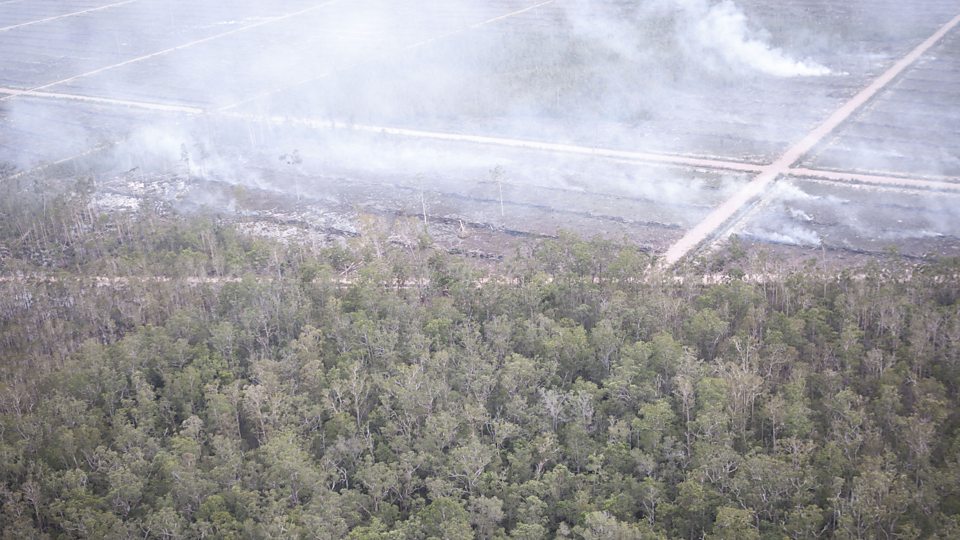
Companies like Korindo have to clear the land in these concessions to allow them to replant new palms. Using fire to do that – the so-called “slash and burn” technique – is illegal in Indonesia due to the air pollution it causes and the high risk blazes will get out of control.

Korindo denies setting fires, saying it follows the law. A 2018 report by the leading global green timber certification body – the Forest Stewardship Council (FSC), of which Korindo is a certificate holder – concluded there was no evidence that illegal and deliberate fires were set by the company.

But according to a new investigation by the Forensic Architecture group at Goldsmiths University in London and Greenpeace International, published in conjunction with the BBC, there is evidence that indicates deliberate burning on the land during the land-clearing period. The investigation found evidence of fires on one of Korindo’s concessions over a period of years in patterns consistent with deliberate use.

Forensic Architecture uses spatial and architectural analysis and advanced modelling and research techniques to investigate human rights violations and environmental destruction. “This is a robust technique that can with a high level of certainty determine if a fire is intentional or not,” said senior researcher Samaneh Moafi. “This allows us to hold the large corporations – who have been setting fires systematically for years now – liable in the court,” she said.

The group used satellite imagery to study the pattern of land clearing inside a Korindo concession called PT Dongin Prabhawa. They used the imagery to study the so-called “normalised burn ratio”, comparing it to hotspot data in the same area – intense heat sources picked up by Nasa satellites, and put the two datasets together over the same period of time, 2011 to 2016.

“We found that the pattern, the direction and the speed with which fires had moved matched perfectly with the pattern, the speed, direction with which land clearing happened. This suggests that the fires were set intentionally,” Samaneh Moafi said.

“If the fires were set from outside the concession or due to weather conditions, they would have moved with a different directionality. But in the cases that we were looking at there was a very clear directionality,” she said.BBC

Watch how the Forensic Architecture Group established what was happening in Papua
Video captionWatch how the Forensic Architecture Group established what was happening in Papua
BBC

Korindo turned down several BBC interview requests, but the company said in a statement that all land clearing was carried out with heavy machinery rather than fires.

It said there were many natural fires in the region due to extreme dryness, and claimed that any fires in its concessions had been started by “villagers hunting giant wild rats hiding under stacks of wood”.

But locals near the concession in Papua told the BBC the company had set fires on the concessions over a period of years, during a timeframe which matched the findings of the visual investigation.

Sefnat Mahuze, a local farmer, said he saw Korindo employees collecting leftover wood, “the worthless stuff”.

“They piled up long rows, maybe 100-200 metres long, and then they poured petrol over it and then lit them,” he said.

Another villager, Esau Kamuyen, said the smoke from the fires “closed the world around them, shutting off the sky”.

According to Greenpeace International, companies are rarely held to account for slash and burn – a practice that almost every year creates a smoky haze in Indonesia which can end up blanketing the entire South East Asian region, causing airports and schools to close.

A Harvard University study estimated that the worst fires in decades in 2015 were linked to more than 90,000 early deaths. The fires that year are also believed to have produced more carbon emissions in just a few months than the entire United States economy.BBC

Papua is home to the largest rainforests in Indonesia

Many of the tribal allegations against Korindo were investigated for two years by the Forest Stewardship Council. The regulator’s tree logo – found on paper products throughout the UK and Europe – is meant to tell consumers the product is sourced from ethnically and sustainable companies. The FSC report into allegations against Korindo was never published, after legal threats from the company, but the BBC obtained a copy.

The report found “evidence beyond reasonable doubt” that Korindo’s palm oil operation destroyed 30,000 hectares of high conservation forest in breach of FSC regulations; that Korindo was, “on the balance of probability … supporting the violation of traditional and human rights for its own benefit”; and was “directly benefitting from the military presence to gain an unfair economic advantage” by “providing unfair compensation rates to communities”.

“There was no doubt that Korindo had been in violation of our rules. That was very clear,” Kim Carstensen, the FSC’s executive director, told the BBC at the group’s headquarters in Germany.

The report recommended unequivocally that Korindo be expelled from the body. But the recommendation was rejected by the FSC board – a move environmental groups say undermined the credibility of the organisation. A letter sent to the FSC board in August, signed by 19 local environmental groups, said the groups could no long rely on the body “to be a useful certification tool to promote forest conservation and respect for community rights and livelihoods”.

Mr Carstensen, the executive director, defended the decision to allow Korindo to stay. “These things have happened, right? Is the best thing to do to say they were in breach of our values so we’re not going to have anything to do with you anymore?” he said.

“The logic of the board has been, ‘We want to see the improvements happen’.”

Korindo strongly denied that the company was involved in any human rights violations but acknowledged there was room for improvements and said it was implementing new grievance procedures.

It said it had paid fair compensation to tribes and that it had paid an additional $8 per hectare for the loss of trees – a sum decided by the Indonesian government, which granted them the concession. The BBC tried to confirm the figure with the Indonesian government, but officials declined to comment on Korindo.

Workers on one of Korindo's palm oil plantations, picking up the palm oil fruit
Workers on one of Korindo’s palm oil plantations, picking up the palm oil fruit

The Indonesian government maintains generally that Papua is an integral part of the nation, recognised by the international community. The province, which is half of the island of New Guinea (the other half belongs to the country of Papua New Guinea), became part of Indonesia after a controversial referendum overseen by the UN in 1969, in which just 1,063 tribal elders were selected to vote.

Since then, control over Papua’s rich natural resources has become a flashpoint in a long-running, low-level separatist conflict. Papuan activists call the 1969 referendum the “act of no choice”.

The Indonesian military has been accused by activist groups of gross human rights abuses in its attempts to suppress dissent in Papua and protect business interests there. Foreign observers are rarely granted access, “because there is something that the state wants to hide”, according to Andreas Harsono, an Indonesian researcher with the US-based Human Rights Watch.

“They are hiding human rights abuses, environmental degradation, deforestation,” he said. “And the marginalisation of indigenous people – economically, socially and politically.”

In an attempt to ease tensions, Papua was granted greater autonomy in 2001, and there has been a significant increase in government funds for the region, with Jakarta vowing to bring prosperity to the people of Papua and saying it is committed to resolving past rights abuses.

"The company didn’t bring prosperity," said Elisabeth Ndiwaen. "What they did was create conflict."
“The company didn’t bring prosperity,” said Elisabeth Ndiwaen. “What they did was create conflict.”

Derek Ndiwaen was one of those in the Mandobo tribe who, like Petrus Kinggo, took money from Korindo for their land. Derek’s sister Elisabeth was away at the time, working in the city, and she didn’t find out about the deal until she returned home. According to Elisabeth, Derek became embroiled in conflict with other tribes over the land deals. She believes the stress played a role in his death.

“My brother would never have sold his pride or forest before,” she said, through tears. “The company didn’t bring prosperity. What they did was create conflict, and my brother was the victim.”

Elisabeth said that her brother was also made promises of free schooling for his children and health care for the family – promises she said were never realised.

“The forest is gone and we are living in poverty,” she said. “After our forest has been sold you would think we would be living a good life. But here in 2020 we are not.”

According to Elisabeth, Korindo told the community it would build good roads and provide clean water.

But residents in her village of Nakias, in the Ngguti district say life hadn’t changed the way they hoped. There’s no clean running water or electricity in the village. Those that can afford it use generators but fuel costs four times as much as in the capital Jakarta.BBC

Environmental activists fear for the Papua rainforest - among the most biodiverse places in the world
Environmental activists fear for the Papua rainforest – among the most biodiverse places in the world

Korindo said that the company directly employs more than 10,000 people and has put $14m (£11m) into social projects in Papua, including food programmes for malnourished children and scholarships.

The company has stopped all further clearing until an assessment of high conservation and high carbon stock forests inside their concessions is carried out.

“The bigger question of what to do with the sins of the past will take a bit of time,” said Kim Carstensen, the FSC chairman. “Whether it’s two years, three years – that I don’t know.”

Elisabeth fears that nothing will make up for the destruction of the rainforest.

“When I see that our ancestral forest is all cleared, chopped down, it’s heart-breaking,” she said. “It should have been passed on to the next generation.”

“I walk through the plantation crying, and ask myself, where are our ancestors’ spirits now that our forest has been completely destroyed. And it happened under my watch.”BBC

Petrus Kinggo's nephew and his generation will inherit a scarred landscape in Papua
Petrus Kinggo’s nephew and his generation will inherit a scarred landscape in PapuaBBC

Petrus Kinggo did receive money from Korindo, he said – about $42,000 (£32,000), equal to 17 years’ pay on the provincial monthly minimum wage. And the company paid for one of his eight children’s school fees until 2017. He said he did not receive a house or a generator, and the money is all gone.

“I have nothing left,” he said. “Uncles, nephews, in-laws, grandchildren, brothers, sisters all took some. And then I spent what was left on my own children’s education.”

Thousands of hectares of the Mandobo tribe’s once vast rainforest has been logged and replaced with neat rows of oil palm trees. A further 19,000 hectares now inside a Korindo concession is earmarked for clearing.

Mr Kinggo is fighting to save some of what’s left. He fears future generations will have to “live off money” rather than the forest. He blames the government for not consulting with the villagers before giving the concession to Korindo and “sending them here to pressure us”.

But when he walks through the forest now, he looks inside, and the money he took weighs on him.

“According to God I have sinned, I deceived 10 tribes,” he said.

“The company said, ‘Thank you Petrus for looking after us so well’. But in my heart I knew I had done wrong.”

BBC

You can watch a film version of this story, The Burning Scar, in the UK on the BBC News Channel on the 21/22 November 2020 at 21:30 GMT and at various times this weekend on BBC World News.

You can also listen to the radio documentary on the BBC World Service here .

Source: https://www.bbc.co.uk/news/

Port Moresby: I have seen too many Evictions

Eviction in Port Moresby, Papua New Guinea

In the past 10 years I have been and seen alot of our Papua new Guinea citizens been treated like criminals and been evicted like aminals and it breaks my heart when I see kids crying and mothers when everything they have built is taken down by police and dozers and there is nothing you can do about it.

Yes the first thing people will say is, “send them back to the village”. The only problem with this is most are 2nd or 3rd generation Highlanders and NGI who have been in the city since birth.
The only reason why people buy blocks and settle in settlements is because there is no other option for citizens. What are they supposed to do when rentals are so high and the cost of the proper land and house is over K400,000. Government has no solutions.
Everyone wants a proper home and our national Government must breach the gap for citizens with a policy that will give solve the following. 1 Family 1 home.
1. Aquire land in NCD and Central Province
2. Land owners and ILG clans be partners in any land development with the state in at rate share agreement.
3. Government puts all trunk infrastructure into the new suburbs, Eda Ranu, PNG power, Telikom. Roads.
4. Each family is identified and land given as equity for small working class families.
5. Government subsidies should cut first home buyers to about K150,000 per home. With BSP facilities it should be accessible since the land is purchased by the government.
I can’t wait until our citizens live in proper structured housing estates, that is the PNG dream. 2017 I put my hand up with my policy team Martin and Francis we have a working policy that will work only problem is political willingness to achieve all our dreams to own our own home.
Good night please my sisters and brothers do you live in block, renting, living with family and wantoks or do you own your own home??

United Tribes of Melanesia!