Cyclone Winston Wreaks Havoc on Fiji

It was one of the South Pacific’s fiercest storms on record.

Cyclone Winston Wreaks Havoc on Fiji
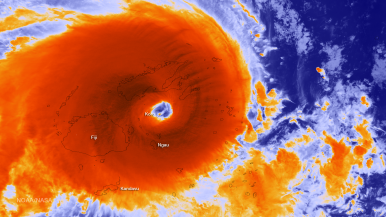
Image Credit: NOAA

Cyclone Winston, which made a direct hit on the Fijian island of Koro over the weekend, was the first Category 5 cyclone to make landfall on Fijian territory in recorded history. The latest reported numbers indicate that 42 people have died as a result of the storm, with aid agencies warning that more may die in the storm’s aftermath as the small country rushes to reach communities on remote islands.

According to the National Oceanic and Atmospheric Administration (NOAA), a U.S. agency, the storm’s winds were estimated to have reached 185 mph. Tom Di Liberto, a meteorologist with NOAA’s climate prediction center, wrote that it  “was one of the strongest storms ever recorded in the Southern Hemisphere.”

With the storm over, the recovery has begun but the task is monumental. The Fijian government declared a month-long state of emergency and put out calls for assistance. The storm did not make a direct hit on the country’s capital, Suva, but wreaked havoc on Koro and many of the country’s other islands. There are more than 330 Fijian islands, about a third of which are inhabited.

Fijian Prime Minister Frank Bainimarama gave a national address Wednesday in which he said, “Almost no part of our nation has been left unscarred.” Per the Sydney Morning Herald, Bainimarama focused attention on immediate concerns: food, water, and shelter.Cyclone Winston flattened homes, caused extensive coastal flooding and knocked out utility and communication systems. The storm also irreparably damaged sugarcane crops.

Radio New Zealand reports that New Zealand, Australia, and France have sent relief flights and the United States, China, India, and the EU have all offered financial assistance. The New Zealand Navy is dispatching the HMNZS Canterbury, a multi-role vessel,  and the HMNZS Wellington, an offshore patrol vessel, loaded with supplies to assist in recovery efforts.

Numerous aid agencies and international organizations have pledged help for Fiji. The Asian Development Bank committed to $2 million in emergency assistance. The Red Cross says it had mobilized more than 300 staff and volunteers in the islands and is releasing emergency funds to the Fiji Red Cross.

Days after the storm aid still seems sluggish for some, as Kim Baker Wilson makes clear in a report for Radio New Zealand from Rakiraki, a district on the northern edge of the island of Fiji’s main island of Vitu Levu. An estimated 1,000 homes were destroyed in Rakiraki.

And more is needed. Ewan Perrin, the newly-appointed permanent secretary for Communication and Information Technology, said that Fiji would “definitely need more international assistance.” From his comments reported by Radio New Zealand, Perrin said Fiji had “everything that we need at this stage” but that more assistance would be needed in the medium to long term.

Fiji’s economy is built on sugar and tourism, both of which are likely to take a massive hit in the storm’s wake.

Last year, Cyclone Pam made a direct hit on Vanuatu, devastating the country. In the months after the storm, Vanuatu’s political system nearly imploded with a quarter of the parliament jailed on corruption charges.

Pacific island nations–like Fiji–have led the charge on climate change globally, sounding the warning siren because their communities will be among the first affected by rising sea levels and worsening storms. Ahead of the Paris climate change talks last year, Bainimarama warned,“Unless the world acts decisively in the coming weeks to begin addressing the greatest challenge of our age, then the Pacific, as we know it, is doomed.”

Green growth, activism & Pacific regionalism – in conversation with Fe’iloakitau Kaho Tevi

Tess Newton Cain, Feiloakitau Kaho Tevi

To reboot Pacific Conversations, Tess recently met with Fei Tevi over coffee in Port Vila. You can hear a podcast of their conversation here and read a transcript here. For the highlights of what they discussed, read on…

I started by asking Fei to fill us in on his background and participation to date in development in the Pacific. Fei is now based in Vanuatu as a result of his wife Eleni’s position at the Melanesian Spearhead Group. He is working as a consultant to the governments of Solomon Islands and Vanuatu, assisting them in developing sustainable development policies and brings with him a wealth of experience in diplomacy, international relations and civil society activism and advocacy.

I am trained in diplomacy and international relations. I worked for the churches for a number of years, over a decade, both in Geneva, Switzerland and also here in the Pacific … prior to that, I was with the Pacific Concerns Resource Center, which is the secretariat to the Nuclear Free and Independent Pacific Movement. Very formative years, ’96 to 2000.

During 2015, Fei participated in the Pacific Islands Development Forum (PIDF) in Suva and was also in Port Moresby for the Pacific Islands Forum leaders’ meeting. So I was keen to find out what he thought the relative strengths and weaknesses are of those regional groupings. In relation to the Pacific Islands Forum, Fei was quick to acknowledge the leadership input of Dame Meg Taylor and said he was watching with interest to see what the further impacts of that would be. He then told me categorically that he thought the issue of West Papua would be critical for the Pacific Islands Forum in the future:

And so this is what I’m saying. The Forum itself, the issue will be a determining factor how they treat West Papua and how they are able to get the political support around the issue. And it won’t go away.

In relation to the PIDF, Fei felt that it had achieved a significant success in 2015 by providing a space for Pacific island leaders to caucus around key issues, especially a joint position for the COP 21 talks in Paris, ahead of the Forum meeting in Port Moresby:

But I think PIDF had a role to play in harnessing the collective momentum of the countries, to stand together and say, “Yes, this is what we need.” And not to be pulled apart … We had one meeting after the other, and people saying the same things and coming right through and holding their stance at the Forum, saying “This is what we want, and this is what you get.” Despite all the pressures, despite all the checkbook diplomacy, everything was up to try and get the Pacific island countries to shift and take position. And kudos to them.

And then he provided a very important statement to define the role and place of the PIDF; one that I feel has not been so clearly and explicitly articulated before now:

…we need to have clarity on what PIDF is. It’s a space. Maintaining that space is a very difficult challenge. Everybody wants to cloud that space, Fiji included. Everybody wants to get that space, monopolise that space. As long as we can keep that space as an opportunity for people to come and talk about issues or challenges, talk about opportunities, discuss deals, that will form the character of PIDF. It’s not a CROP agency. It will not deliver on water tanks and water and sanitation programs. It’s not geared towards that.

We then moved on to discuss the concept of ‘green growth’ in the Pacific context, which is an aspect of development with which Fei has been very involved in recent years. I began by asking him how he conceptualises the Pacific concept of green growth, given that it appears to be something that has yet to achieve one accepted definition globally:

In the work that we’ve been doing over the last 3-4 years, in the Pacific, green growth has to do with lifestyles; green growth has to do with a sustainable approach to development. Green growth has to do with—the maturity of the countries to determine where and how they want to address development.

He sees the Pacific conceptualisation of green growth as being one that goes beyond technological interventions. So, next, I asked Fei to give me some sense of what green growth means in a practical sense. How can it or should it influence the way Pacific island countries do business? He took as his starting point the resilience of the communities in Vanuatu further to the impacts of Cyclone Pam last year.

…that for me expresses a set of values that for me green growth encompasses … And that’s part of, I guess, a sense of maturity that we are going through. The recognition that there is something that we can learn and that the future of the region, in terms of green growth, it’s within us. We need to find the tools to identify this and to identify those components of what we can achieve. So that’s one example we can quote. Examples of which time and time again, the resilient nature of these communities has expressed itself with or without help or foreign assistance. So we need to think about that. We need to think how that defines, how that defines growth for us.

Drawing on Fei’s longstanding and extensive involvement with civil society activism in our region, I asked him how he assessed the current capacity within that sector to influence national and regional decision-making about the important issues that we face. He reflected on the changing nature of activism in the region, which he felt had been blunted as a result of becoming ‘institutionalised’ in the 1990s. However, more recently, he had seen resurgence particularly around the issues of self-determination for West Papua and climate change activism:

You have the new environmental activists that are coming through, the young Solwarans, the Young Solwara movement, the Wan Solwara movement, the other groups that have— … PICAN, Pacific Islands Climate Action Network. These are all young, new activists that are coming through.

I expressed a concern that a weakness for civil society at present in our region is a lack of access to and influence with governments. Fei was quite clear that governments in the region should do much more to include civil society in relevant discussions and policy formulation:

… I think we cannot point five of our fingers at civil society. I think there’s a lot of responsibility also that governments have to take on in terms of how they deal with civil society… there has to be a revisiting of what civil service means, and being a civil servant. You are a servant of the government, and by government means the people. So you serve the people. It’s not the other way around. The people don’t come in on their knees to come and ask for service. They shouldn’t. Citizens, rightfully, ask and request their assistance, and their service. Then I think there needs to be a give and take in this discussion.

Finally, we discussed the impact of the election of ‘Akilisi Pohiva as prime minister of Tonga and what it means for democracy in that country. He was quick to acknowledge that the early months have proved disappointing in some ways:

I think in the longer run, in the medium to long term, I think there’s a lot of benefit that can accrue from ‘Akilisi and his time, and his government being in place. I think there’s a lot of lessons that can be taken from the first year or so of ‘Akilisi’s government. A lot of questionable decisions.

He then went on to make a very interesting observation in relation to what we can expect from Tonga in terms of regional participation:

There is more good than bad—there’s more strengths than weaknesses that’s coming out of this government. The fact that, you know, Tonga has taken a strong stance on the issue of West Papua is a token of that and you will see, you will see this government taking on regional issues in a much more stronger way than in the past. The first year has been about consolidating and shifting the country at the national level. I think you will see Tonga playing a more influential role in the region in the future.

…something to look forward to, for sure.

Tess Newton Cain is a Visiting Fellow at the Development Policy Centre. Fe’iloakitau Kaho Tevi is a consultant to the governments of Solomon Islands and Vanuatu on sustainable development policies, and has experience in diplomacy, international relations and civil society activism and advocacy.

Sea-level rise ‘could last twice as long as human history’

Research warns of the long timescale of climate change impacts unless urgent action is taken to cut emissions drastically

Huge sea-level rises caused by climate change will last far longer than the entire history of human civilisation to date, according to new research, unless the brief window of opportunity of the next few decades is used to cut carbon emissions drastically.

Even if global warming is capped at governments’ target of 2C – which is already seen as difficult – 20% of the world’s population will eventually have to migrate away from coasts swamped by rising oceans. Cities including New York, London, Rio de Janeiro, Cairo, Calcutta, Jakarta and Shanghai would all be submerged.

“Much of the carbon we are putting in the air from burning fossil fuels will stay there for thousands of years,” said Prof Peter Clark, at Oregon State University in the US and who led the new work. “People need to understand that the effects of climate change won’t go away, at least not for thousands of generations.”

“The long-term view sends the chilling message of what the real risks and consequences are of the fossil fuel era,” said Prof Thomas Stocker, at the University of Bern, Switzerland and also part of the research team. “It will commit us to massive adaptation efforts so that for many, dislocation and migration becomes the only option.”

The report, published in the journal Nature Climate Change, notes most research looks at the impacts of global warming by 2100 and so misses one of the biggest consequences for civilisation – the long-term melting of polar ice caps and sea-level rise.

This is because the great ice sheets take thousand of years to react fully to higher temperatures. The researchers say this long-term view raises moral questions about the kind of environment being passed down to future generations.

The research shows that even with climate change limited to 2C by tough emissions cuts, sea level would rise by 25 metres over the next 2,000 years or so and remain there for at least 10,000 years – twice as long as human history. If today’s burning of coal, oil and gas is not curbed, the sea would rise by 50m, completely changing the map of the world.

“We can’t keep building seawalls that are 25m high,” said Clark. “Entire populations of cities will eventually have to move.”

By far the greatest contributor to the sea level rise – about 80% – would be the melting of the Antarctic ice sheet. Another new study in Nature Climate Changepublished on Monday reveals that some large Antarctic ice sheets are dangerously close to losing the sea ice shelves that hold back their flow into the ocean.

Huge floating sea ice shelves around Antarctica provide buttresses for the glaciers and ice sheets on the continent. But when they are lost to melting, as happened the with Larsen B shelf in 2002, the speed of flow into the ocean can increase eightfold.

Johannes Fürst, at the University of Erlangen-Nürnberg in Germany and colleagues, calculated that just 5% of the ice shelf in the Bellingshausen Sea and 7% in the Amundsen Sea can be lost before their buttressing effect vanishes. “This is worrying because it is in these regions that we have observed the highest rates of ice-shelf thinning over the past two decades,” he said.

Avoiding the long-term swamping of many of the world’s greatest cities is already difficult, given the amount carbon dioxide already released into the atmosphere. “Sea-level rise is already baked into the system,” said Prof Stocker, one of the world’s leading climate scientists.

However, the rise could be reduced and delayed if carbon is removed from the atmosphere in the future, he said: “If you are very optimistic and think we will be in the position by 2050 or 2070 to have a global scale carbon removal scheme – which sounds very science fiction – you could pump down CO2 levels. But there is no indication that this is technically possible.” A further difficulty is the large amount of heat and CO2 already stored in the oceans.

Prof Stocker said: “The actions of the next 30 years are absolutely crucial for putting us on a path that avoids the [worst] outcomes and ensuring, at least in the next 200 years, the impacts are limited and give us time to adapt.”

The researchers argue that a new industrial revolution is required to deliver a global energy system that emits no carbon at all. They conclude: “The success of the [UN climate summit in] Paris meeting, and of every future meeting, must be evaluated not only by levels of national commitments, but also by looking at how they will lead ultimately to the point when zero-carbon energy systems become the obvious choice for everyone.”

“We are making choices that will affect our grandchildren’s grandchildren and beyond,” said Prof Daniel Schrag, at Harvard University in the US. “We need to think carefully about the long timescales of what we are unleashing.

Collapsing Greenland glacier could raise sea levels by half a metre, say scientists

Huge Zachariae Isstrom glacier has begun to break up, starting a rapid retreat that could continue to raise sea levels for decades to come

Does foreign aid always help the poor?

https://www.weforum.org/agenda/authors/ana-swanson, Source: https://www.weforum.org/

It sounds kind of crazy to say that foreign aid often hurts, rather than helps, poor people in poor countries. Yet that is what Angus Deaton, the newest winner of the Nobel Prize in economics, has argued.

Deaton, an economist at Princeton University who studied poverty in India and South Africa and spent decades working at the World Bank, won his prize for studying how the poor decide to save or spend money. But his ideas about foreign aid are particularly provocative. Deaton argues that, by trying to help poor people in developing countries, the rich world may actually be corrupting those nations’ governments and slowing their growth. According to Deaton, and the economists who agree with him, much of the $135 billion that the world’s most developed countries spent on official aid in 2014 may not have ended up helping the poor.

The idea of wealthier countries giving away aid blossomed in the late 1960s, as the first humanitarian crises reached mass audiences on television.  Americans watched through their TV sets as children starved to death in Biafra, an oil-rich area that had seceded from Nigeria and was now being blockaded by the Nigerian government, as Philip Gourevitch recalled in a 2010 story in the New Yorker. Protesters called on the Nixon administration for action so loudly that they ended up galvanizing the largest nonmilitary airlift the world had ever seen. Only a quarter-century after Auschwitz, humanitarian aid seemed to offer the world a new hope for fighting evil without fighting a war.

There was a strong economic and political argument for helping poor countries, too. In the mid-20th century, economists widely believed that the key to triggering growth — whether in an already well-off country or one hoping to get richer — was pumping money into a country’s factories, roads and other infrastructure. So in the hopes of spreading the Western model of democracy and market-based economies, the United States and Western European powers encouraged foreign aid to smaller and poorer countries that could fall under the influence of the Soviet Union and China.

The level of foreign aid distributed around the world soared from the 1960s, peaking at the end of the Cold War, then dipping before rising again. Live Aid music concerts raised public awareness about challenges like starvation in Africa, while the United States launched major, multibillion-dollar aid initiatives. And the World Bank and advocates of aid aggressively seized on research that claimed that foreign aid led to economic development.

Deaton wasn’t the first economist to challenge these assumptions, but over the past two decades his arguments began to receive a great deal of attention. And he made them with perhaps a better understanding of the data than anyone had before. Deaton’s skepticism about the benefits of foreign aid grew out of his research, which involved looking in detail at households in the developing world, where he could see the effects of foreign aid intervention.

“I think his understanding of how the world worked at the micro level made him extremely suspicious of these get-rich-quick schemes that some people peddled at the development level,” says Daron Acemoglu, an economist at MIT.

The data suggested that the claims of the aid community were sometimes not borne out. Even as the level of foreign aid into Africa soared through the 1980s and 1990s, African economies were doing worse than ever, as the chart below, from a paper by economist Bill Easterly of New York University, shows.

151023-foreign aid Africa Angus Deaton Wonk Blog

William Easterly, “Can Foreign Aid Buy Growth?”

The effect wasn’t limited to Africa. Many economists were noticing that an influx of foreign aid did not seem to produce economic growth in countries around the world. Rather, lots of foreign aid flowing into a country tended to be correlated with lower economic growth, as this chart from a paper byArvind Subramanian and Raghuram Rajan shows.

The countries that receive less aid, those on the left-hand side of the chart, tend to have higher growth — while those that receive more aid, on the right-hand side, have lower growth.

Why was this happening? The answer wasn’t immediately clear, but Deaton and other economists argued that it had to do with how foreign money changed the relationship between a government and its people.

Think of it this way: In order to have the funding to run a country, a government needs to collect taxes from its people. Since the people ultimately hold the purse strings, they have a certain amount of control over their government. If leaders don’t deliver the basic services they promise, the people have the power to cut them off.

Deaton argued that foreign aid can weaken this relationship, leaving a government less accountable to its people, the congress or parliament, and the courts.

“My critique of aid has been more to do with countries where they get an enormous amount of aid relative to everything else that goes on in that country,” Deaton said in an interview with Wonkblog. “For instance, most governments depend on their people for taxes in order to run themselves and provide services to their people. Governments that get all their money from aid don’t have that at all, and I think of that as very corrosive.”

It might seem odd that having more money would not help a poor country. Yet economists have long observed that countries that have an abundance of wealth from natural resources, like oil or diamonds, tend to be more unequal, less developed and more impoverished, as the chart below shows. Countries at the left-hand side of the chart have fewer fuels, ores and metals and higher growth, while those at the right-hand side have more natural resource wealth, yet slower growth. Economists postulate that this “natural resource curse” happens for a variety of reasons, but one is that such wealth can strengthen and corrupt a government.

curse

Like revenue from oil or diamonds, wealth from foreign aid can be a corrupting influence on weak governments, “turning what should be beneficial political institutions into toxic ones,” Deaton writes in his book “The Great Escape: Health, Wealth, and the Origins of Inequality.” This wealth can make governments more despotic, and it can also increase the risk of civil war, since there is less power sharing, as well as a lucrative prize worth fighting for.

Deaton and his supporters offer dozens of examples of humanitarian aid being used to support despotic regimes and compounding misery, including in Zaire, Rwanda, Ethiopia, Somalia, Biafra, and the Khmer Rouge on the border of Cambodia and Thailand. Citing Africa researcher Alex de Waal, Deaton writes that “aid can only reach the victims of war by paying off the warlords, and sometimes extending the war.”

He also gives plenty of examples in which the United States gives aid “for ‘us,’ not for ‘them’” – to support our strategic allies, our commercial interests or our moral or political beliefs, rather than the interests of the local people.

The United States gave aid to Ethiopia for decades under then-President Meles Zenawi Asres, because he opposed Islamic fundamentalism and Ethiopia was so poor. Never mind that Asres was “one of the most repressive and autocratic dictators in Africa,” Deaton writes. According to Deaton, “the award for sheer creativity” goes to Maaouya Ould Sid’Ahmed Taya, president of Mauritania from 1984 to 2005. Western countries stopped giving aid to Taya after his government became too politically repressive, but he managed to get the taps turned on again by becoming one of the few Arab nations to recognize Israel.

Some might argue for bypassing corrupt governments altogether and distributing food or funding directly among the people. Deaton acknowledges that, in some cases, this might be worth it to save lives. But one problem with this approach is that it’s difficult: To get to the powerless, you often have to go through the powerful. Another issue, is that it undermines what people in developing countries need most — “an effective government that works with them for today and tomorrow,” he writes.

The old calculus of foreign aid was that poor countries were merely suffering from a lack of money. But these days, many economists question this assumption, arguing that development has more to do with the strength of a country’s institutions – political and social systems that are developed through the interplay of a government and its people.

There are lot of places around the world that lack good roads, clean water and good hospitals, says MIT’s Acemoglu: “Why do these places exist? If you look at it, you quickly disabuse yourself of the notion that they exist because it’s impossible for the state to provide services there.” What these countries need even more than money is effective governance, something that foreign aid can undermine, the thinking goes.

Some people believe that Deaton’s critique of foreign aid goes too far. There are better and worse ways to distribute foreign aid, they say. Some project-based approaches — such as financing a local business, building a well, or providing uniforms so that girls can go to school — have been very successful in helping local communities. In the last decade, researchers have tried to integrate these lessons from economists and argue for more effective aid practices.

Many people believe that the aid community needs more scrutiny to determine which practices have been effective and which have not. Economists such as Abhijit Banerjee and Esther Duflo, for example, argue for creating randomized control trials that allow researchers to carefully examine the development effects of different types of projects — for example, following microcredit as it is extended to people in poor countries.

These methods have again led to a swell in optimism in professional circles about foreign aid efforts. And again, Deaton is playing the skeptic.

While Deaton agrees that many development projects are successful, he’scritical of claims that these projects can be replicated elsewhere or on a larger scale. “The trouble is that ‘what works’ is a highly contingent concept,” he said in an interview. “If it works in the highlands of Kenya, there’s no reason to believe it will work in India, or that it will work in Princeton, New Jersey.”

The success of a local project, like microfinancing, also depends on numerous other local factors, which are harder for researchers to isolate. Saying that these randomized control trials prove that certain projects cause growth or development is like saying that flour causes cake, Deaton writes in his book. “Flour ‘causes’ cakes, in the sense that cakes made without flour do worse than cakes made with flour – and we can do any number of experiments to demonstrate it – but flour will not work without a rising agent, eggs, and butter – the helping factors that are needed for the flour to ‘cause’ the cake.”

Deaton’s critiques of foreign aid stem from his natural skepticism of how people use — and abuse — economic data to advance their arguments. The science of measuring economic effects is much more important, much harder and more controversial than we usually think, he told The Post.

Acemoglu said of Deaton: “He’s challenging, and he’s sharp, and he’s extremely critical of things he thinks are shoddy and things that are over-claiming. And I think the foreign aid area, that policy arena, really riled him up because it was so lacking in rigor but also so grandiose in its claims.”

Deaton doesn’t argue against all types of foreign aid. In particular, he believes that certain types of health aid – offering vaccinations, or developing cheap and effective drugs to treat malaria, for example — have been hugely beneficial to developing countries.

But mostly, he said, the rich world needs to think about “what can we do that would make lives better for millions of poor people around the world without getting into their economies in the way that we’re doing by giving huge sums of money to their governments.” Overall, he argues that we should focus on doing less harm in the developing world, like selling fewer weapons to despots, or ensuring that developing countries get a fair deal in trade agreements, and aren’t harmed by U.S. foreign policy decisions.

Deaton also believes that our attitude toward foreign aid – that developed countries ought to swoop in and save everyone else – is condescending and suspiciously similar to the ideas of colonialism.  The rhetoric of colonialism, too, “was all about helping people, albeit about bringing civilization and enlightenment to people whose humanity was far from fully recognized,” he has written.

Instead, many of the positive things that are happening in Africa – the huge adoption in cell phones over the past decade, for example – are totally homegrown. He points out that, while the world has made huge strides in reducing poverty in recent decades, almost none of this has been due to aid. Most has been due to development in countries like China, which have received very little aid as a proportion of gross domestic product and have “had to work it out for themselves.”

Ultimately, Deaton argues that we should stand aside and let poorer countries develop in their own ways. “Who put us in charge?” he asks.

This article is published in collaboration with Washington Post. Publication does not imply endorsement of views by the World Economic Forum.

To keep up with the Agenda subscribe to our weekly newsletter.

Author: Ana Swanson is a reporter for Wonkblog specializing in business, economics, data visualization and China.

Image: People carry food aid distributed. REUTERS/Antonio. 
Democracy, custom and the Melanesian Way

By Susan Merrell, http://www.pngecho.com/

Is there a democratic Papua New Guinean nation – or is it merely an arbitrary state built on a shaky, crumbling foundation of disparate traditional customs and the ‘Melanesian Way’? Has the system of government become a hybrid of concepts that fail to work on any level – a bastardization of both democracy and custom?

melanesian_wayBernard Narokobi in his book ‘The Melanesian Way’ refused to define the conceptt:

According to Narokobi, those posing the question are “cynics”, “hypocrites” and display “spiteful arrogance.”  The concept is “cosmic” making a definition “futile” and “trite.”  He failed to explain how so.

Apparently, if Moses didn’t ask God to define himself then the messianic Narokobi should not be required to define the Melanesian Way – notwithstanding that he was writing a book about it, making one wonder what the rest of the book is about.

The idea of belonging to the ‘insider’ group that carries the knowledge of the Melanesian Way is so emotionally charged and identity defining that it usually provokes wide-eyed head nodding – but no conceptual challenge.

Yet, concepts only defy explanation when they are not widely understood. Given the nebulous nature of the ‘Melanesian Way’, it has become an exploitable idea.

Prime Minister, Peter O’Neill and his previous coalition partner, Belden Namah when in government, reconciled their differences just hours after Namah had gone on national radio demanding that O’Neill resign.  They explained their curious and confusing behaviour as being the ‘Melanesian Way.’

Friends in politics: Before O'Neill relegated Namah to opposition and subsequently expelled Polye who then unseated Namah to wrest the opposition leadership..
Friends in politics:
Before O’Neill relegated Namah
to opposition
and subsequently expelled
Polye who then unseated Namah to
wrest the opposition leadership.

The reconciliation proved tenuous when, despite their Memorandum of Understanding ongoing into the elections, O’Neill froze out Namah relegating him and his party to the opposition benches while preferring to rekindle old alliances with the Grand Chief (in 2015, the alliance is tenuous) and other veteran power brokers.

It suggests that the Melanesian Way is redolent with self-serving pragmatism and a fickle approach to commitment that can be called on, or not, according to whim.

If Namah thought that the Melanesian Way was going to work for him as he bad-mouthed his former coalition partner, he’d seriously miscalculated. This was western-style politics.

Customary Practices and alien concepts

The customary practices of the Big Man and the wantok system worked well in a small, encapsulated tribal community – it doesn’t translate into the modern political structure of a nation/state where favouring of wantoks is nepotism and arbitrary distribution of largesse in return for allegiance is bribery.  When these customary practices are tolerated within the modern PNG machinery of government, compliance with democratic principles becomes populist lip service.

Introduced, western principles and PNG cultural practices co-exist uncomfortably.  The Christian religion, for instance, missionary imposed, it is now widely embraced.  To be faithful to both social systems requires a series of compromises that either makes a mockery of Christian doctrines or insults the integrity of custom.

Fashioned along the line of the Jewish faith, the Seventh-Day Adventist (SDA) Church, for example, forbids the consumption of pork and shellfish.  But pork is the ceremonially meat, and shellfish are a staple part of the diet of those that live on the coast and outlying islands of PNG.

In PNGs social media site ‘Sharp Talk’, there has been a lengthy conversation trying to reconcile Christianity with tradition by seeking a biblical justification for the customary practise of polygamy.

Although PNG has laws against adultery, polygamy is tolerated.  But is polygamy just another name for adultery?  Does the law, (based on Christian ethics) or custom take precedence in PNG or does that depend on the perpetrator?

At independence, PNG was also left with a political legacy that was alien and ill understood and often at loggerheads with custom.

Nicholas Bainton in his book ‘The Lihir Destiny’, noted that in the very first national elections in which Lihirians took part, many locals had no idea what was required.  They wanted to vote for US President Johnson – as they had pleasant memories of the generosity of the Americans stationed there during World War II. It all fitted into a traditional context they understood – President Johnson becoming their ‘Big Man’.

Former MP, Moses Maladina
Former MP,
Moses Maladina

In the middle of the recent elections, two helicopter loads of armed PNG Defence Force personnel landed at Ess’ala Station in Milne Bay.  They stormed the police station and took control of the ballot counting by force.  The returning officer for the area hid, fearing for his life.

The area’s incumbent MP, Moses Maladina had deployed the troops.

Electoral Commission figures had Maladina behind in the count – he never caught up, eventually losing his parliamentary seat.  Was this a factor in the deployment?  Was it a justification?

Maladina is a Big Man – even more so as he recently was awarded a medal in the Queen’s Honour birthday list. Interestingly, the imperial award cements and extends his customary stature: Big Man tribally; Big Man nationally and now internationally.

Perhaps, under PNG custom, Maladina was just doing what would be expected of him as a tribal chief – defending his patch, with force if necessary.

Whatever the justification, Maladina stopped short of physically leading the charge himself. ‘Big Chief Maladina’ sat that one out.

Belden Namah - as he stormed the Supreme Court with his 'storm troopers' to arrest the Chief Justice, mid session
Belden Namah – as he stormed the
Supreme Court with his ‘storm troopers’
to arrest the Chief Justice, mid session

Not so Belden Namah as he stormed the Supreme Court last May to defend his patch.

What hope democracy when quasi-legitimate force is used to stifle the democratic process?

Western law when co mingled with custom proves untenable

While innocent until proven guilty is a western, democratic legal paradigm that has been embraced tightly – especially by the elite of PNG – law enforcement is totally inadequate and open to bastardization by quasi-traditional practices like bribery and a reverence of the untouchable Big Man.

So disdainful are many Big Men towards the law that they simply ignore it as in the recent bribery charges against former Speaker Jeffrey Nape who simply failed to turn up at court.

Former Speaker, Jeffrey Nape, a National Alliance heavyweight

To Nape criminal charges are not a novelty, he knows they’re rarely pursued.

Big Man status insulated, Maladina, Nape and Namah from western-style justice – however, that paradigm shifts a little with their fall from grace. Now their fate securely rests with the conquering chief (O’Neill) according to his whim.

For democracy, this is disastrous.

For while parliamentarians may have the customary status of ‘Big Man’, they are not in the village – they are overseeing and participating in a democratic national government – village rules don’t apply and status should not offer impunity from the rules of the system in which they are participating – although, at present, it does.

In light of the hybrid nature of governance, is PNG really a nation or is it an anomalous entity where the democratic political administration of the state has become a series of vested interests paying lip service to national sentiment and democracy?

Whereas in most first-world countries, self-conscious nations create nationalism in a bid for self-determination and statehood, PNG already has a state – but what of the nation?

Democracy, custom and the Melanesian Way

Is there a democratic Papua New Guinean nation – or is it merely an arbitrary state built on a shaky, crumbling foundation of disparate traditional customs and the ‘Melanesian Way’? Has the system of government become a hybrid of concepts that fail to work on any level – a bastardization of both democracy and custom?

melanesian_wayBernard Narokobi in his book ‘The Melanesian Way’ refused to define the conceptt:

According to Narokobi, those posing the question are “cynics”, “hypocrites” and display “spiteful arrogance.”  The concept is “cosmic” making a definition “futile” and “trite.”  He failed to explain how so.

Apparently, if Moses didn’t ask God to define himself then the messianic Narokobi should not be required to define the Melanesian Way – notwithstanding that he was writing a book about it, making one wonder what the rest of the book is about.

The idea of belonging to the ‘insider’ group that carries the knowledge of the Melanesian Way is so emotionally charged and identity defining that it usually provokes wide-eyed head nodding – but no conceptual challenge.

Yet, concepts only defy explanation when they are not widely understood. Given the nebulous nature of the ‘Melanesian Way’, it has become an exploitable idea.

Prime Minister, Peter O’Neill and his previous coalition partner, Belden Namah when in government, reconciled their differences just hours after Namah had gone on national radio demanding that O’Neill resign.  They explained their curious and confusing behaviour as being the ‘Melanesian Way.’

Friends in politics: Before O'Neill relegated Namah to opposition and subsequently expelled Polye who then unseated Namah to wrest the opposition leadership..
Friends in politics:
Before O’Neill relegated Namah
to opposition
and subsequently expelled
Polye who then unseated Namah to
wrest the opposition leadership.

The reconciliation proved tenuous when, despite their Memorandum of Understanding ongoing into the elections, O’Neill froze out Namah relegating him and his party to the opposition benches while preferring to rekindle old alliances with the Grand Chief (in 2015, the alliance is tenuous) and other veteran power brokers.

It suggests that the Melanesian Way is redolent with self-serving pragmatism and a fickle approach to commitment that can be called on, or not, according to whim.

If Namah thought that the Melanesian Way was going to work for him as he bad-mouthed his former coalition partner, he’d seriously miscalculated. This was western-style politics.

Customary Practices and alien concepts

The customary practices of the Big Man and the wantok system worked well in a small, encapsulated tribal community – it doesn’t translate into the modern political structure of a nation/state where favouring of wantoks is nepotism and arbitrary distribution of largesse in return for allegiance is bribery.  When these customary practices are tolerated within the modern PNG machinery of government, compliance with democratic principles becomes populist lip service.

Introduced, western principles and PNG cultural practices co-exist uncomfortably.  The Christian religion, for instance, missionary imposed, it is now widely embraced.  To be faithful to both social systems requires a series of compromises that either makes a mockery of Christian doctrines or insults the integrity of custom.

Fashioned along the line of the Jewish faith, the Seventh-Day Adventist (SDA) Church, for example, forbids the consumption of pork and shellfish.  But pork is the ceremonially meat, and shellfish are a staple part of the diet of those that live on the coast and outlying islands of PNG.

In PNGs social media site ‘Sharp Talk’, there has been a lengthy conversation trying to reconcile Christianity with tradition by seeking a biblical justification for the customary practise of polygamy.

Although PNG has laws against adultery, polygamy is tolerated.  But is polygamy just another name for adultery?  Does the law, (based on Christian ethics) or custom take precedence in PNG or does that depend on the perpetrator?

At independence, PNG was also left with a political legacy that was alien and ill understood and often at loggerheads with custom.

Nicholas Bainton in his book ‘The Lihir Destiny’, noted that in the very first national elections in which Lihirians took part, many locals had no idea what was required.  They wanted to vote for US President Johnson – as they had pleasant memories of the generosity of the Americans stationed there during World War II. It all fitted into a traditional context they understood – President Johnson becoming their ‘Big Man’.

Former MP, Moses Maladina
Former MP,
Moses Maladina

In the middle of the recent elections, two helicopter loads of armed PNG Defence Force personnel landed at Ess’ala Station in Milne Bay.  They stormed the police station and took control of the ballot counting by force.  The returning officer for the area hid, fearing for his life.

The area’s incumbent MP, Moses Maladina had deployed the troops.

Electoral Commission figures had Maladina behind in the count – he never caught up, eventually losing his parliamentary seat.  Was this a factor in the deployment?  Was it a justification?

Maladina is a Big Man – even more so as he recently was awarded a medal in the Queen’s Honour birthday list. Interestingly, the imperial award cements and extends his customary stature: Big Man tribally; Big Man nationally and now internationally.

Perhaps, under PNG custom, Maladina was just doing what would be expected of him as a tribal chief – defending his patch, with force if necessary.

Whatever the justification, Maladina stopped short of physically leading the charge himself. ‘Big Chief Maladina’ sat that one out.

Belden Namah - as he stormed the Supreme Court with his 'storm troopers' to arrest the Chief Justice, mid session
Belden Namah – as he stormed the
Supreme Court with his ‘storm troopers’
to arrest the Chief Justice, mid session

Not so Belden Namah as he stormed the Supreme Court last May to defend his patch.

What hope democracy when quasi-legitimate force is used to stifle the democratic process?

Western law when co mingled with custom proves untenable

While innocent until proven guilty is a western, democratic legal paradigm that has been embraced tightly – especially by the elite of PNG – law enforcement is totally inadequate and open to bastardization by quasi-traditional practices like bribery and a reverence of the untouchable Big Man.

So disdainful are many Big Men towards the law that they simply ignore it as in the recent bribery charges against former Speaker Jeffrey Nape who simply failed to turn up at court.

Former Speaker, Jeffrey Nape, a National Alliance heavyweight

To Nape criminal charges are not a novelty, he knows they’re rarely pursued.

Big Man status insulated, Maladina, Nape and Namah from western-style justice – however, that paradigm shifts a little with their fall from grace. Now their fate securely rests with the conquering chief (O’Neill) according to his whim.

For democracy, this is disastrous.

For while parliamentarians may have the customary status of ‘Big Man’, they are not in the village – they are overseeing and participating in a democratic national government – village rules don’t apply and status should not offer impunity from the rules of the system in which they are participating – although, at present, it does.

In light of the hybrid nature of governance, is PNG really a nation or is it an anomalous entity where the democratic political administration of the state has become a series of vested interests paying lip service to national sentiment and democracy?

Whereas in most first-world countries, self-conscious nations create nationalism in a bid for self-determination and statehood, PNG already has a state – but what of the nation?

Source: http://www.pngecho.com/

Aid Dependency: The Damage of Donation

Written by Victoria Stanford, University of Edinburgh (Contact: ~Written by Victoria Stanford, University of Edinburgh (Contact: vstanford@hotmail.co.uk)

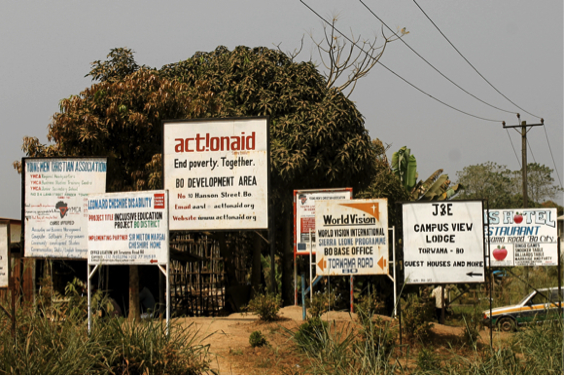
  "The Culture of Aid Dependency Need to Change," David Sengeh, Sierra Leone. Photo Credit: www.engineeringforchange.org
“The Culture of Aid Dependency Need to Change,” David Sengeh, Sierra Leone. Photo Credit: www.engineeringforchange.org

Aid has long been the response of richer countries to the imbalance of economic development seen across the globe. In the last two decades however, relatively non-intrusive in-kind giving has been re-branded and intensified to the point where aid today is arguably used as a strategic force in increasingly interventionist global development policy. The aid industry has seen a rapid expansion, characterised by an increase in the number of organisations, amounts of funding and geographical reach (Collinson and Duffied, 2013). The question of aid dependence is an important one; many argue that international assistance paradoxically poses a barrier to recipient country development and sustainable economic growth (Moyo, 2009).

Recent rhetoric surrounding aid dependency is clear- it is an unwelcome and unfortunate side effect of aid and its diminishment is high on the aid policy agenda (Thomas et al., 2011). What is becoming increasingly clear however is that there is an emerging type of aid-related dependency that does not refer to economic or financial factors, but political. Cases of corruption in recipient country governments have been met with the development of more complex modes of donation, including direct programme funding, conditionalities, tied aid, and grants, which give donors more control over the direction and ultimate use of their funds. This often means that those providing aid are increasingly entwined in political processes. This combined with aid uncertainty, questionable sustainability, and a tendency of top-down approaches to political involvement, create a situation where countries in need of aid are dependent upon foreign agendas.

How has aid caused dependency?

Aid dependency refers to the proportion of government spending that is given by foreign donors. Since 2000 this has in fact decreased by one third in the world’s poorest countries, exemplified by Ghana and Mozambique where aid dependency decreased from 47% to 27% and 74% to 58% respectively (3). Aid is not intrinsically linked to dependency; studies have shown that dependency is influenced by many factors, mostly length and intensity of the donation period, and 15-20% has been identified as the tipping point where aid begins to have negative effects (Clemens et al., 2012). What causes dependency is when aid is used, intentionally or not, as a long-term strategy that consequently inhibits development, progress, or reform. Food aid is particularly criticised for this; increasing dependency on aid imports disincentivises local food production by reducing market demand. This is compounded when declining aid is replaced with commercial imports rather than locally-sourced food, either because of cheaper prices or a lack of recipient country food production capacity because of long-term aid causing agricultural stagnation (Shah, 2012). This is exemplified in the situation of Haiti, which is dependent on cheap US imports for over 80% of grain stocks even in a post-aid era, or countries such as the Philippines where aid dependency has forced an over-reliance on cash crops. Dependency relates not only to commodities but also technical expertise and skills which donors often bring to specific aid schemes and projects, which when not appropriately coupled with education create an over-reliance on donors (Thomas et al., 2011).

A more concerning type of dependency

The nature of aid almost intrinsically causes what is increasingly known as ‘political dependency’ by encouraging donor intervention in political processes. Donors need to satisfy the interests, values and incentives of the home country, whilst also providing them with expected results in order to maintain the cash flow. This has resulted in donors either bypassing and therefore destabilising government service provision processes to establish donor projects, a strategy often favoured by USAID and the World Bank (Bräuntigam and Knack, 2004), or intervening directly in policy-making and implementation (Bräutigam, 2000).

The involvement of donors, either foreign governments or international agencies, in recipient country political processes has been shown to reduce the quality of governance (Knack, 2001). It reduces leader accountability; the government is “playing to two audiences simultaneously”- the donors and the public (Hayman, 2008). This means the direction of accountability is between government and donor rather than the public, risking government legitimacy and delaying the progress of political reform and development (Bräutigam, 2000). This is particularly damaging in countries where the need for aid stems from political upheaval or civil unrest such as the Democratic Republic of Congo or Zimbabwe, which have a lengthy history of aid dependence (Moss et al., 2006). The risk here is that donors have political leverage, thus decisions and planning become reliant on donor involvement whose motivation and values may not necessarily align with those of the public or government.

Furthermore, ‘earmarking’ is a strategy favoured by many international donors who fear corruption in recipient governments, therefore ‘earmark’ direct sector or programme funding rather than general government budget support (Foster and Leavy, 2001). This not only shifts the agenda-making power to donors who have the authority to set priorities and direct funds accordingly, but also creates patchy and unsustainable development where some sectors outperform others.

An additional significant problem of dependency upon international agenda-making for countries receiving aid is that globally recommended ‘best practice’ policies often lack appropriate contextualisation to cultural, religious, or social values. A top-down, uniform approach to policy implementation by donors also has logistical barriers whereby local infrastructure is incapable of carrying out donor projects effectively and producing satisfactory results. A good example of this is the widely-disseminated policy encouraging syndromic management of sexually transmitted diseases, which was coercively incorporated into aid channels in Mozambique, despite the clear lack of the technical expertise and human resource capacity that such a robust policy requires (Cliff et al., 2004). This then perpetuates aid dependency because donors do not receive satisfactory project results and may consequently reduce funding without actually solving the problem, thus the poverty cycle continues and aid is required once again.

Demolishing aid dependency

Ending or preventing aid dependency will be contingent on affirmative action from both donors and recipients. Botswana is a key example of recipient-led aid policy that effectively resulted in rapidly reducing aid and therefore dependency. Botswana began receiving aid shortly after gaining independence in 1966 (Bräutigam and Botchwey, 1999). Of primary importance here is that Botswana largely decided the direction and use of funding; areas of priority were identified and donors were matched accordingly, thus avoiding reliance on donor ideas and agendas. Only projects that the predicted government capacity could absorb once aid was reduced in the long-term were undertaken, which ensured sustainability. In contrast, the relative ‘success story’ of Taiwan can be explained by donor-led project planning. Taiwan received much aid from the US in the early 1960’s which focused mainly on building infrastructural capacity-docks, railways, factories-with the aim to increase trading systems and boost the economy. In fact, this scheme was so effective that the US eventually withdrew aid for fear of creating competition (Chang, 1965).

It seems evident that recipient-led schemes and projects are more effective and reduce the risk of dependency. Technically speaking, some argue that aid should only ever be in the form of general government budget support rather than selective sector or project aid because it reduces donor involvement in political processes. It is also less bureaucratic, is less influenced by donor missions who need to produce and report results, and avoids the risk of uneven service provision (Moss et al., 2006). Ideologically speaking, the aid industry today is at risk of forming a novel kind of colonialism where ‘Western’ ideas of development and progress are used to influence and hold power over governments of countries receiving aid.

Concluding thoughts

The aid industry must respond to the problem of economic and political dependence. Coordinated efforts to more effectively monitor donor-recipient relationships, using a widely implemented human rights-based legal and moral framework for aid policy should be the ultimate, collective goal (Ooms and Hammonds, 2008). The reality is however that with increasingly complex humanitarian disasters and the destructive forces of climate change looming, the aid industry will be called upon to increase capacity and intensity which may perhaps re-direct focus from implementing ideological change. Nevertheless, the opportunity to ‘get things right’ in aid policy and practice persists, and it is a moral imperative that the industry and its participants make the attempt.

References:

  1. Bräutigam D and Botchwey K (1999) The institutional impact of aid dependence on recipients in Africa. Chr. Michelsen Institute;Working Paper 1.
  2. Bräutigam, D. (2000). Aid dependence and governance, Almqvist & Wiksell International;Stockholm pp.14.
  3. Bräuntigam D and Knack S (2004) Foreign aid, institutions and governance in Sub-Saharan Africa, Economic Development and Cultural Change, Vol 52;2, pp.255-285.
  4. Chang D (1965) US Aid and Economic progress in Taiwan, Asian Survey, Vol 5;3, pp.152-160.
  5. Clemens MA, Radelet S and Bhavnani R (2012) Counting Chickens when they Hatch: Timing and the Effects of Aid on Growth, The Economic Journal, 122(561), 590-617.
  6. Cliff J, Walt G and Nhatave, I (2004) What’s in a Name? Policy transfer in Mozambique: DOTS for tuberculosis and syndromic management for sexually transmitted infections. Journal of Public Health Policy, 25;1, p.38-55
  7. Collinson S and Duffied M (2013) Paradoxes of Presence:Risk Management and aid culture in challenging environments, Humanitarian Policy Group, Overseas Development Institute [Online] Available at: http://www.odi.org/sites/odi.org.uk/files/odi-assets/publications-opinion-files/8428.pdf [Accessed 02 January 2015].
  8. Foster M and Leavy J (2001) The choice of financial aid instruments. London: Overseas Development Institute, pp.4.
  9. Hayman R (2008) Rwanda: milking the cow. Creating policy space in spite of aid dependence. The Politics of Aid, 156.
  10. Knack S (2001) Aid dependence and the quality of governance: cross-country empirical tests, Southern Economic Journal, 310-329.
  11. Moss T, Pettersson G andVan de Walle, N (2006) An aid-institutions paradox? A review essay on aid dependency and state building in sub-Saharan Africa, Centre for Global Development; Working paper No. 74.
  12. Moyo D (2009) Dead Aid, Penguin; London, pp.12
  13. Ooms G and Hammonds R (2008) Correcting globalisation in health: transnational entitlements versus the ethical imperative of reducing aid-dependency. Public Health Ethics, 1(2), 154-170.
  14. Shah A (2012) Food aid, Global Issues [Online] Available at: URL: http://www. globalissues. org/article/748/food-aid [Accessed January 02 2015]
  15. Thomas A, Viciani L and Tench J et al (2011) Ending Aid Dependency, Action Aid; London.

Help small island states win their battle against climate change

Earth’s fate is inextricably linked to 52 nations threatened by rising sea levels – the rest of the world should not let them drown

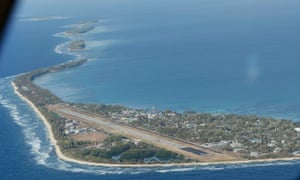
In this Oct. 13, 2011 photo, Funafuti, the main island of the nation state of Tuvalu, is seen from a Royal New Zealand airforce C130 aircraft as it approaches at Funafuti, Tuvalu, South Pacific. Funafuti is the capital of Tuvalu, a group of atolls situated north of Fiji and northwest of Samoa, in the South Pacific ocean. The atolls are suffering a severe drought and water shortage, coupled with contaminated ground water due to rising sea levels. The governments of Australia, New Zealand and the United States are providing desalination plants to alleviate the critical water shortage for some 10,000 islanders. (AP Photo/Alastair Grant)Many of the planet’s most prized destinations, places considered exquisite and idyllic, where nature seems bountiful and people appear at ease, are under threat. In less than a decade, climate change-induced sea level rise could force thousands of people to migrate from some of the world’s 52 small island developing states (Sids).

How Sids respond to threats such as sea level rise, and the degree of support they receive, is indicative of how we, collectively, will adapt to a host of climate change impacts in the coming decades.

When we think of Sids, we may be tempted to imagine small patches of paradise scattered with lightly populated fishing villages, unfettered by the demands of modernity. In fact, almost one in every 100 of us is from a small island developing state.

Sids boast a diversity of cultures, natural resources, biodiversity, and indigenous knowledge that makes them mainstays of our planetary ecosystem. From the multi-billion dollar economy of Singapore, to Papua New Guinea, one of the least explored countries in the world where 1,000 cultural groups are thought to exist, to the very remote Niue, which is one of the world’s largest coral islands – each small island developing state is endowed with its own unique attributes.

Yet what they increasingly share in common are escalating environmental threats that are further aggravated by economic insecurities. Sea level rise is among the most daunting of these threats, which in some regions is up to four times the global average.

According to recent Intergovernmental Panel on Climate Change estimates, if average global temperatures increase by approximately 4C, sea levels could rise as much as one metre by 2100, a scenario that would see nations such as Kiribati, Maldives, Marshall Islands and Tuvalu become uninhabitable, while a large share of the population of many other Sids could be displaced or otherwise.

What makes this situation even more grievous is that the climate change threats facing many Sids are by-and-large not of their own making. Their total combined annual carbon dioxide output, although rising, accounts for less than 1% of global emissions.

Sids are suffering disproportionately from acts of environmental negligence of which we are collectively guilty. Larger economies, until recently, have managed better than small ones to mask the impacts of exhausting their natural capital and contributing heavily to greenhouse gas emissions, but the consequences of this neglect are catching up with them too.

Kiribati
Pinterest
 A girl sits on a log next to the roots of a tree near the village of Teaoraereke on South Tarawa in the central Pacific island nation of Kiribati. The country consists of a chain of 33 atolls and islands that stand just metres above sea level. Photograph: David Gray/Reuters

Responses to these threats that apply the business-as-usual economic models that have brought them to the state of economic and environmental vulnerability they are in today will be temporary at best, and catastrophic at worst. That is why Sids are beginning to take the first steps on a blue-green economy transition – a strategy that targets resource efficiency and clean technology, is carbon neutral and socially inclusive, will provide a healthy environment and help conserve resources, while integrating traditional knowledge and giving priority to island community and culture that will build their resilience to the impacts of climate change.

But we should not look at climate change threats in isolation from other influenced by human activities, because climate change is in fact exacerbating problems that we have already created, such as desertification, biodiversity loss, and food insecurity.

Take the degradation of marine ecosystems as an example. A number of studies show that it is overfishing that currently outweighs all other human impacts on marine ecosystems, including climate change. With Sids accounting for seven out of 10 of the world’s countries most dependent on fish and seafood consumption, reducing emissions alone will not be enough to ensure a sufficient supply of fish in the future.

The governments of these small island states are recognising that many policies of the past have left them ill-prepared to respond to the impacts of climate change, and it is this awareness that is motivating them to make sustainable economic growth the cornerstone of their development.

The energy sector, where they are leading the switch to renewables, is a prime example of necessity driving innovation and change. On average, Pacific island households spend approximately 20% of their household income on energy, and can often pay up to 400% more per kilowatt-hour of electricity than the United States.

As a result, many states are now developing their domestic renewable energy markets. For instance, the small South Pacific island of Tokelau is close to meeting 100% of its energy needs through renewables – even powering generators with locally produced coconut biofuel.

And Barbados, already the leading producer of solar water heaters in the Caribbean, is set to save an estimated $283.5m (£171m) through a 29% switch to renewables by 2029.

From valuing and managing their natural resources, to putting the right incentives in place to switch to renewable energy, Sids are leading the blue-green economy transition. And next week, at the third international conference on Sids in Samoa, they will reaffirm their commitment to advancing national sustainable development goals in front of a global audience. What they need from the rest of the world is the solidarity, technologies, and resources to act on that commitment on a scale that will radically change their fortunes.

It is hoped that the new international climate change agreement currently being negotiated, and which will be adopted at the Paris conference in 2015, might help to relieve some of their economic burden of adapting to the impacts of climate change, while also reducing the severity of the impacts by reducing global greenhouse gas emissions.

Supporting Sids on this journey of transition provides an unprecedented opportunity to be part of game-changing socioeconomic solutions that can be applied in broader contexts and bigger economies.

We should look upon Sids as microcosms of our larger society, and not stand back and allow them to grapple with a threat for which they are largely inculpable.

Source: https://www.theguardian.com/

Andy Ayamiseba: Black Brothers Bukan Kelompok Musisi Biasa

Jayapura, 11/3 (Jubi)- Andy Ayamiseba, manajer Grup Band Black Brothers,  mengatakan Black Brothers bukan sekadar kelompok musisi biasa. Mereka memiliki visi dan misi utama untuk mengangkat martabat bangsanya yang selalu dibilang masih terbelakang.

“Misi dan visi yang kedua untuk menciptakan masyarakat yang adil dan sejahterah serta yang ketiga dan maha penting adalah untuk membebaskan bangsanya dari segala bentuk penindasan oleh kaum penjajah,”katanya,melalui akun Facebooknya, belum lama ini.

Menurut Ayamiseba, misi itu bisa dibuktikan dengan karya-karya mereka  melalui syair lagu-lagu nya dan keputusan-keputusan yang diambil untuk meninggalkan ketenaran mereka di tanah airnya Indonesia. Bahkan, kemudian meninggalkan kontrak musik di EMI Holland dan akhirnya hijrah ke Vanuatu untuk menjalankan lobi OPM di kawasan Pasifik Selatan, termasuk PNG.

Para personel BB pun diseleksi berdasarkan potensi-potensi mereka secara individu agar produksi bisa mencapai hasil yang semaksimal mungkin. Jocky Phu, dijuluki si pena emas karena dia adalah penyair besar yang berwatak cinta damai dan keadilan. Kemudian, Hengky (alm) yang memiliki suara emas yang khas Black Brother dan sulit diganti oleh suara lain.

Sijari emas August Rumaropen (alm) dijuluki George Bensonnya Papua dengan watak halus dan rendah hati. Ada juga Benny pada bass dan Stevie si penabuh drum. Keduanya adalah tulang punggung rythm section-nya. Akhirnya David(Dullah) dan Amry yang menciptakan dandanan rythem musik BB. Paduan musik dan vokal mereka yang harmonis sesuai dengan melodi dan syair lagu-lagunya telah menembus nusantara dan Pasifik Selatan. Hal ini  membuat grup musik Black Brother melegenda di Pasifik Selatan, Indonesia,  dan Eropah dengan lagu Jalikoe.

“Saya selaku pendiri dan manajer sekaligus produser eksekutif supergroup ini sulit untuk mendapatkan musisi-musisi alam yang diberkati dengan talenta oleh Tuhan Yang Maha Kuasa seperti mereka. Saya sangat berterima kasih dan bangga karena diberkati dengan kesempatan untuk bekerja dengan group legendaris ini,”tulis Ayamiseba.

Lebih lanjut jelas Ayamiseba Black Brothers adalah suatu persembahan yang berpaduan antarwatak kepribadian talenta, seni, komitmen, dan inspirasi. “Semoga apa yang telah dirintis oleh musisi-musisi alam ini dapat dilanjutkan oleh generasi penerus demi suksesnya misi dan visi mereka,”harap pejuang Papua Merdeka di Vanuatu, Mr Andy Ayamiseba.

Grup Black Brother pertama kali tampil di Jayapura memakai nama Iriantos Primitive, menjelang persiapan show ke Papua New Guinea. Saat itu musisi dan artis-artis Papua bergabung dan berlatih serius guna tampil prima merayakan kemerdekaan Papua New Guinea(PNG)dirumah pribadi menejer Black Borthers Andy Ayamiseba. Sayangnya upaya mengembangkan misi kesenian Papua dan show musik ke negara tetangga PNG tak mendapat restu dari pemerintah pusat di Jakarta.

“Black Brothers pada awalnya bernama Iriantos Primitive. Saya bentuk grup ini untuk tur keliling ke PNG dengan grup tarian yang kemudian izinnya ditolak oleh Departemen Pendidikan dan Kebudayaan di Pusat,”katanya kepada tabloidjubi.com via Facebook.com belum lama ini.

Manajer Black Brothers ini mengaku pada usia yang ke 27 tahun, tepatnya pada 1974 sudah memimpin Group Band Black Brothers. “Setahun setelah izin ke PNG ditolak, saya membuat rencana baru untuk memenuhi visi dan misi tersebut lewat Jakarta. Demikianlah sejarah rekaman Black Brothers dimulai,”tulis Andy Ayamiseba.

Putra seorang mantan pejabat Ketua Dewan Perwakilan Rakyat Gotong Royong (DPR GR) Provinsi Irian Barat, mendiang Dirk Ayamiseba ini tampil sebagai pebisnis dan musisi di era 1960-1970 an. Andy Ayamiseba sudah bergabung dengan Group Band Varunas salah satu group band milik Angkatan Laut yang cukup terkenal saat itu.

Tim musisi kesenian Irian Jaya yang tergabung dalam Iriantos Primitive mempunyai anggota-anggota awalnya terdiri dari alm Mimi Fatahan mahir bermain musik Hawaian, Ricky Chaay vokalis, Corry Rumbino vocalis dan Musa Fakdawer vocalis. “Latihan musik dan tarian mengambil tempat latihan di garasi rumah milik Andy Ayamiseba di Angkasa Indah, Kota Jayapura,”kata Andy Ayamiseba.

“Varunas Band adalah band milik Angkatan Laut Daerah X dan saya sendiri adalah salah satu anggota dari Band Varunas sebagai slide gitarist,Danny Kadmaer (lead gitrais/vocalis);Herman(basist); Ringgo Kadmaer (drummer);Mulyadi (Keyboard/gitaris); brass section adalah anggota-anggota TNI A. Sedangkan penyanyi penyanyi adalah Bass Lanoh; Ricky Chaay; Marcel Siante alias Honda;dan Dolf Raharusun,”kata Andy Ayamiseba.

Group Band Varunas selalu berlatih di kediaman Panglima Daeral X, Commodore Indra Kusnaedi di Nirwana, Angkasa Kota Jayapura.Saat itu ada musisi Nani kadmaer, saudara tertua dari Ringgo, Nani tidak pernah menjadi anggota Grup Band Varunas.

“Sebelumnya Kadmaer bersaudara bergabung dalam Group Band Aneka Ria yang dikenal sebagai Koes Bersudaranya Papua. Dengan vocal harmonis yang luar biasa dari Danny dan Nany,”kenang Andy Ayamiseba saat bermain band di Kota Jayapura.

Bermodal sebagai musisi dan pengusaha yang memiliki usaha di bawah perusahaan bernama PT Bintuni Baru (BB). Manajer Black Brothers ini mulai menancapkan tajinya dalam musik dan lagu di blantika musik Indonesia. Rencana show ke Papua New Guinea bersama Iriantos Primitive tak mendapat ijin membuatnya melanjutkan misi musik ke Jakarta.

Pada 1976 pertama kali Black Brothers tampil di Senayan, sepanggung dengan SAS Group Rock Arthur Kaunang eks personel AKA Group. Show ini mampu membuat seisi stadion histeris dan group musik asal Papua ini berhasil menaklukan Jakarta. “Saat Hengky MS membawakan lagu Soldier of Fortune dari Deep Purple. Kontan seluruh penonton di Senayan histeris dan kagum kalau ada grop musik dari timur Papua,”kata Musa Fakdawer, salah satu musisi Papua yang juga tergabung dalam Iriantos Primitive.(Jubi/dominggus a mampioper)

United Tribes of Melanesia!